




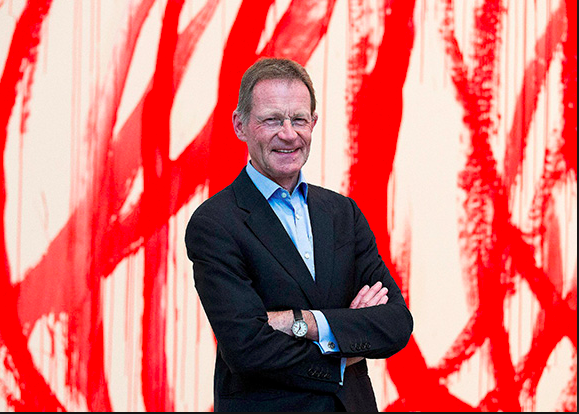
Nick Serota was in Sydney this week, courtesy of John Kaldor, to deliver an address on art education. The former director of the Tate galleries, now head of the Arts Council, is an object lesson in leanness and austerity. There is an absolute focus with everything he says and does, with no wastage. One would imagine Serota’s personal style would fit him up to be an apologist for the cutbacks and belt-tightening that most governments around the world seem ready to inflict on the arts. Instead, he is a formidable advicate for art and art education, able to argue his case from an economic point-of-view, and from a broader cultural perspective.
Serota reminded his audience that it was John Maynard Keynes who stood behind the formation of the Arts Council in 1946. Keynes saw value in the arts, and in the ideal of a broad liberal education, that has been jettisoned by economists weaned by Chicago School economic rationalism, who have sought to put a dollar value on everything. Yet when we forsake the qualitative for the purely quantitative we lose much of what makes us human.
Speaking to the slogan formulated by artist, Bob and Roberta Smith – All Schools Should Be Art Schools – Serota noted that knowledge today can be obtained with the flick of a button, meaning that creativity and imagination should take priority in any meaningful education system. He quoted research that showed how students that excell in arts-based subjects tend to do better in other subjects as well.
All these arguments have been rehearsed many times in many parts of the world. The problem is getting narrow-minded politicians and bureaucracies to take them seriously. To this end it was amazing to hear the NSW Minsiter for Education, Rob Stokes, use words like “ontological” and “ heuristic” in a brief preliminary address. Mr Stokes also outlined a progressive – almost futuristic – vision for reforming the NSW education system. It was startling, to say the least, given this government’s appalling track record on supporting the arts, and the cultural vandalism apparent in the plan to move the Powerhouse Museum. One suspects Mr Stokes will have either a brilliant career or a brief career.
As for his educational vision, I’ll believe it when I see it in action.
This week’s column is devoted to the first ever Bangkok Art Biennale, which turned out to be the best of the four Biennales I visited in the space of a fortnight, outdistancing the shows in Busan, Gwangju and Seoul. The latter, at Seoul Media City, was nothing short of an embarrassment. Gwangju was much better, although rather too big and too ambitious for its own good. Busan got closest to the mark, being a more focused affair, with a better core group of artists.
Bangkok, on the other hand, had a few genuinely inspired moments, and provided an important showcase for talented local artists. There was a palpable commitment and enthusiasm that suggests this show will be around for many years to come, if only Thailand can enjoy a decent stretch of political stability.
The movie under consideration this week, is Michael Moore’s Fahrenheit 11/9– a typically frustrating, immoderate performance for this film-maker-activist. There’s never a topic that doesn’t provoke Moore into going over-the-top, but the rise of Donald Trump and the appalling acts of Michigan Governor, Rick Snyder, provide plenty of fuel for his indignation. If one can deal with the showmanship and the selective nature of his facts, Moore presents a devastating portrait of the United States in decline. While he also celebrates acts of popular resistance and wants us to see there is another side to American life, he has assembled enough damning facts to sabotage any bursts of optimism.