




First a bit of housekeeping. I’ve had it pointed out that many people are getting notices saying “this site may be hacked”, when accessing the home page. The site is not hacked (at present!) so don’t be put off by these warnings. There are also new hiccups that are interfering with access, so if you can’t get onto the site from the header, or even the art review, click on the film column. I’m endeavouring to fix all these problems within the next few weeks, so hang in there with my apologies.
****
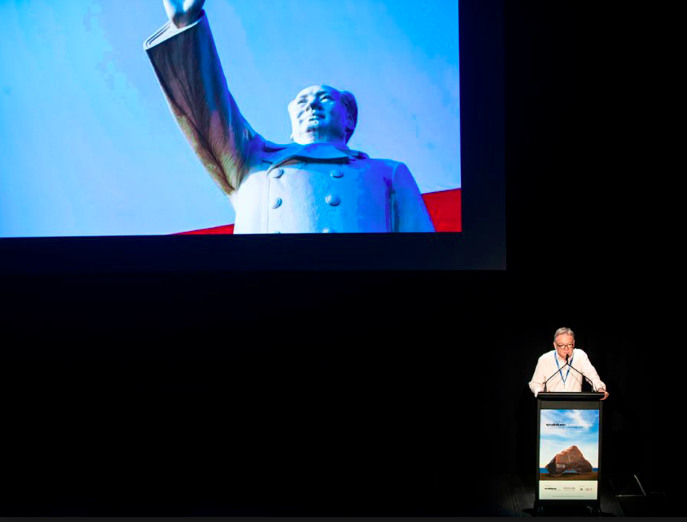
One of the most interesting points to emerge from this week’s Sculpture by the Sea conference was the difference between Australia and China in matters of public art and art education. The sheer weight of population makes a difference of course, but there is much in the Chinese system that we could take to heart. The Central Academy of Fine Arts in Beijing is the unquestioned top of the tree among Chinese art schools, so one cannot expect every institution to have the same advantages. Nevertheless it was sobering to realise that sculpture students at CAFA spend the first three years of their course acquiring skills and working out an area of potential specialisation. After three years of foundation they spend another two years working with teachers and mentors. When they graduate they are confronted with a country that believes so strongly in public art that there are more than 60 major projects underway in western China alone.
In brief, when you study at CAFA you are guaranteed to acquire useful skills, and stand an excellent chance of pursuing a lifelong career as an artist. In Australia, after three years in which you mightlearn something, depending on your luck with schools and instructors, you are given a diploma and sent out into a world in which very few manage to make careers as professional artists.
In the current political climate there is little chance that governments of either persuasion will address these problems. Tertiary education is increasingly viewed as a way of raising money from fees, not as a means of equipping students with the tools to improve our world. The arts are seen as the most expendable and impractical of educational options.
Don Harwin, the NSW Minister for the Arts, is proud of his record in resisting calls to move or amalgamate the National Art School. In a more balanced world he’d be boasting about the resources he is putting into art schools, museums and regional galleries across the board. In reality, the government has an appalling record in this respect.
Is it necessary to live in a centralised, one-party state for the arts to be taken seriously? Probably not, but it seems to help. We may have our political freedoms but they come at the cost of an alarming trivialisation of education and culture.
Another politically dubious place where culture is taken seriously is Russia. This week’s art review looks at Masters of Modern Art from the Hermitageat the Art Gallery of NSW. The Hermitage in St. Petersburg is like an academy for curators, who have to serve a lengthy apprenticeship learning their trade before they are given any genuine responsibilites. At the AGNSW most of the senior curatorial staff have retired or resigned over the past decade, leaving junior staff to take over their duties. The curator’s role is taken far less seriously than that of a fund-raiser, which is an excellent way of putting the cart before the horse.
Masters of Modern Artis not the greatest show to travel to Australia in recent years – on a work for work basis, the 2015 exhibition from the National Gallery of Scotland was much stronger – but it does contain 8 Matisses and 8 Picassos, and that makes it essential viewing.
This week’s film review discusses Luca Guadagnino’s remake of Suspiria– an object lesson in not going to the cinema with great expectations. I’ve always been a fan of Dario Argento’s original Suspiriaof 1977, which is one of the greatest horror movies of all time. I’ve also liked everything Luca Guadagnino has done up until this point, but was profoundly disappointed by this remake. The new Suspiriais not devoid of interest but the plot rambles all over the place, and does nothing to improve on the original story. A relocation to 1970s Berlin opens to door to a raft of potentous themes that feel extraneous to the main action. Maybe it’s time for filmmakers to stop using Berlin as an atmospheric excuse for every second-rate attempt at story-telling.