




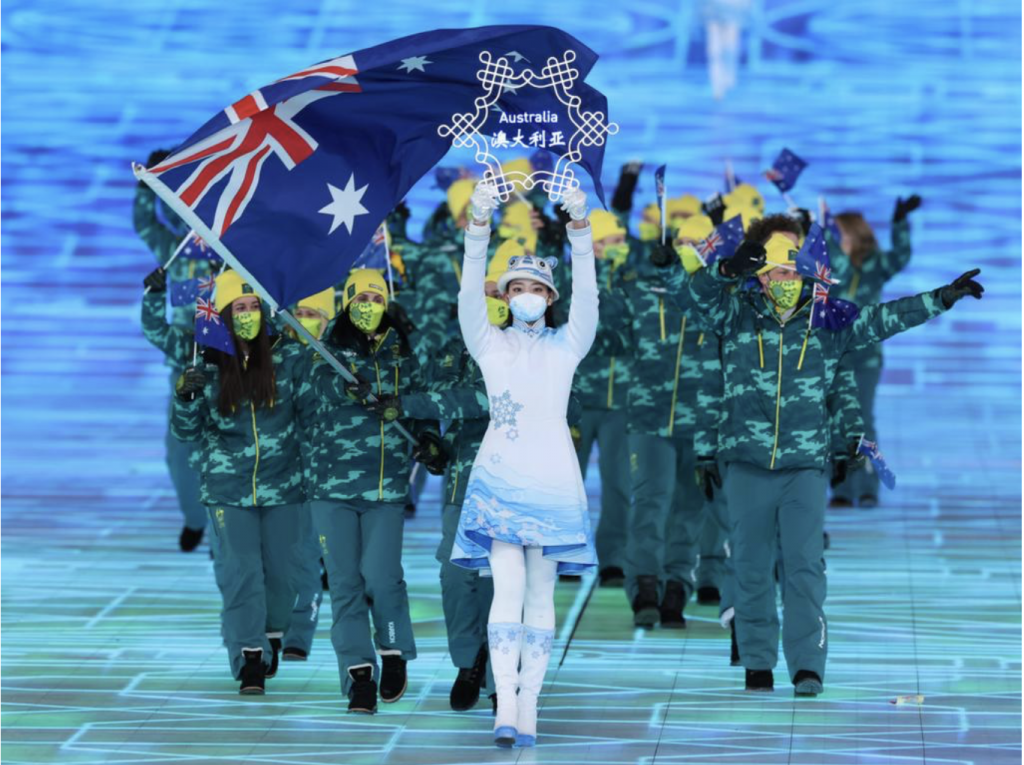
As usual, one can only have mixed feelings about the Olympics opening ceremonies. On one hand it was the familiar cavalcade of kitsch – right down to the choice of music, from John Lennon’s Imagine to Beethoven’s Ninth. All those noble sentiments expressed about the need for everyone to live together in peace and harmony sounded a little hollow when the only notable world leader in attendance was Vladimir Putin, busy massing troops on the Ukraine’s borders. Nevertheless, the spectacle was a technical marvel, and there is always something touching about the idealism expressed – perhaps in a slightly hollow fashion – by the Olympics. For two weeks we call a moratorium on global tensions and age-old animosities between states, pretending we really do “live as one”, as John Lennon put it, wetly.
The Olympics acts as a regular safety valve for all the global pressures that keep building daily. It allows countries to compete without resorting to threats of war and other forms of intimidation. The world can temporarily suspend its outrage over China’s human rights policies (or lack of), and hope that the good will generated by the Games will help soften a rigid, hostile political stance.
Most likely, when it’s all over, it’ll back to the fighting and name-calling. All the bullish talk about an economic rebound this year suggests that as soon as the pandemic is declared over – probably prematurely, by some government desperate to say they’ve defeated the virus – we’ll be crowding out public spaces, spending money on all sorts of junk, and setting ourselves up for more trouble. Surely, the first priority should be getting the so-called developing world vaccinated before the next strain of COVID-19 comes surging towards us. One presumes, however, that there are more important things to spend money on, such as tax cuts for big business. As we learned this week, the federal government is already economising by cutting payments to children with autism and other disabilities. It’s yet another thoughtful way of removing money from unproductive members of society so more can be handed to good people such as Gerry Harvey.
Speaking of money well spent, it was hardly surprising to learn from a NSW auditor general’s report that the government of the late Saint Gladys managed to allocate 96% of their $252 million Stronger Communities Fund to Coalition-held electorates. This is in line with Her Holiness’s stated view that there’s nothing wrong with pork-barrelling, because “everybody does it”. You have to admit she’s a straight-shooter. It’s just a shame that she has such a poor memory, not being able to recall so many things when the ICAC asked her a few simple questions, and having completely forgotten the text exchange in which she called Scummo “a horrible, horrible person”. It was probably such a commonplace among the Libs it was hardly worth remembering. Besides, it hasn’t prevented Optus from hiring her to sit on their board, where she’ll undoubtedly continue to demonstrate the integrity we’ve come to expect.
It was a not-so-good week (again) for our Great Leader in Canberra, who took another savaging from the inappropriately named Grace Tame, during the Grace and Brittany Show at the National Press Club. It must be galling that the women’s event seemed to be so much more successful than the PM’s “reset” of the previous week.
You’ll recall that Grace looked like she’d rather be anywhere but standing next to a smirking Scummo during the Australian of the Year ceremonies. What we didn’t know was that she’d already been told by a yet-to-be-identified public servant she must not do anything to make Our Leader look bad, as an election was in the offing. The rest of the story we already know.
Not only was Grace indelicate enough to actually mention this, she even poured scorn on the idea that the government would hold an inquiry into the allegations. She said the government’s approach “seems to consist of nothing but empty announcements, placatory platitudes, superficial last-minute acknowledgements, and carefully staged photo ops, facades and false hope”. Which sounds about right.
This week’s art column is devoted to Destination Sydney: the Natural World, the third and last installment of this would-be popular exhibition. Despite the David Attenborough-style title, this time it’s really a showcase for women artists, with three each being featured at the S.H.Ervin Gallery, Mosman Art Gallery, and Manly Art Gallery & Museum. It’s the predictable mixed bag, but with enough good work to make it worth recommending to art-starved gallery-goers.
The movie being reviewed is Drive My Car, a film that took my breath away in what’s turning out to be a promising year at the movies. Ryusuke Hamaguchi has come out of nowhere to stamp himself one of the great emerging directors of our era. There’s so much that could be said about this intimate, melancholy film, it’s best I don’t get started here.
A third piece this week is an obituary on Jutta Feddersen, who has died at the age of 90. Jutta was a remarkable person whose childhood was spent in a war-torn hellhole in what is now Poland. In later life she was a fearless artist who recognised no boundaries between art and craft. Trained a weaver she became a maker of large-scale sculptures and installations. She was tough, determined and humane, shaped by life experiences that are almost inconceivable to most of us today. When I hear about some delicate creature being traumatised because someone didn’t use their preferred pronoun, I think of people like Jutta.