




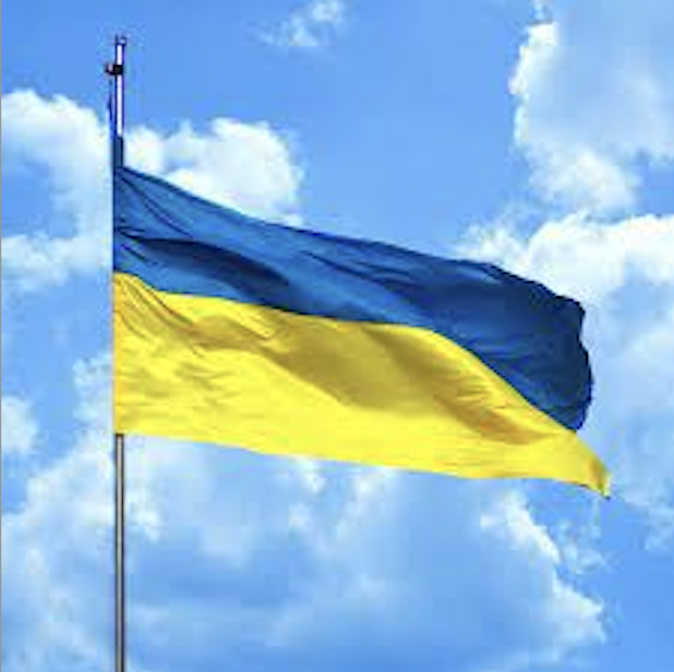
Another week when art seems to pale into insignificance alongside the major events of the day. The war in Ukraine appears more diabolical whenever one turns on the TV, and looks like it’s only going to get worse. Meanwhile, the NSW north coast is under water, and it seems the Lismore Regional Gallery may have suffered huge damage to its permanent collection as floodwaters rose more than 15 metres.
With the war I’m a little surprised how often I hear that America is really to blame for ‘interfering’ in Ukraine – as if Putin wouldn’t have touched the country otherwise. The other great claim is that it’s Europe’s fault for allowing the Baltic States to align with NATO, thereby antagonising Putin unnecessarily. All this seems to assume that: 1. the entire world should devote itself to appeasing Putin 2. Putin plays by the rules and is a man who sticks to his word (or threats).
Simple fact: NATO is an organisation devoted to keeping the peace, not attacking other countries or expanding national borders. Putin doesn’t like NATO breathing down his neck because it interferes with his long-cherished territorial ambitions.The fact that Trump was able to throw NATO into such turmoil allowed Putin to keep building his arsenal and his war chest while his opponents argued amongst themselves.
It seems impossible to believe anyone could take Putin seriously when he raves about the Neo-Nazi regime in Ukraine, which was in some way threatening Russia’s security. This woud make Zelensky a Jewish Nazi, which would be a quite a combo.
Nevertheless, when I found myself with a Russian taxi driver the other day and mentioned the war, thinking it must be tough to be Russian expat at present, he launched into a ferocious diatribe about the Ukrainian nazis who have murdered 13,000 people in Crimea, and are nothing but puppets of the US. In his book, Putin was fighting the just fight and the west was peddling criminal disinformation. This “13,000” claim would turn up again on the ABC’s Q & A one night later – it is a complete distortion of a UN report into years of conflict in the Donbas region.
My taxi driver was rather a shock, as I naively believed that any Russians living in Australia, were probably happy to be out of Putin’s clutches. I felt like I’d just fallen down the rabbit hole. I had the same feeling in Canberra recently when I found myself surrounded by anti-vax protesters draped in flags and festooned with banners. It wasn’t at all threatening – more like a big day out for mum, dad and the kids, who all seemed to believe they were doing something noble and patriotic. They were all sharing the love, and turned to look at me, with my mask, as if I were a poor deluded fool.
It’s not simply that people have lost faith in mainstream media and politicians, they have embraced the most bizarre conspiracy theories and extremist propaganda, and are now so emotionally invested they can’t allow themselves the slightest doubt. They believe whatever fits in with their existing prejudices and dismiss everything else as a lie. Social media has welded these disparate types into a virtual community that becomes a real community when everyone gathers for rallies and protests. Here the psychology of the crowd takes hold: welding individuals into one mass mind. All this is taking us down a very dark tunnel with increasing speed, as history suggests most people never shake off their fanatical beliefs until some terrible disaster has taken place. That disaster is happening in the Ukraine, and it seems increasingly likely there’ll be mayhem of another stripe in the United States before too long.
Australia, as usual, is lagging behind, but there are plenty of elements (Step up Clive Palmer!) willing to drag us into the abyss. It almost makes one thankful that we’re only ruled by petty, self-serving clowns. Scummo and the Boiled Egg have yet to declare New Zealand a security threat and launch an invasion, although if the polling gets much worse it might be wise for the Kiwis to consider a few basic defensive measures.
This week’s art column puts aside the review format and takes a look at the Museum of Contemporary Art in a time of transition. I’ve tried to put the museum into context and look at the ideas behind such an institution. There’ll be plenty of opportunities for reviews down the track.
The film being discussed, slightly against my better judgement, is Dune. I thought I’d avoided further comment on this disappointing cultish saga, but the AFR has asked me to write up all the candidates for Best Picture at this year’s Academy Awards, and I’m still counting down. I only wish they hadn’t stretched the short list to ten titles. Personally, I would’ve settled for four, and certainly no more than six. I wonder when a “short” list officially becomes a “long” one?