




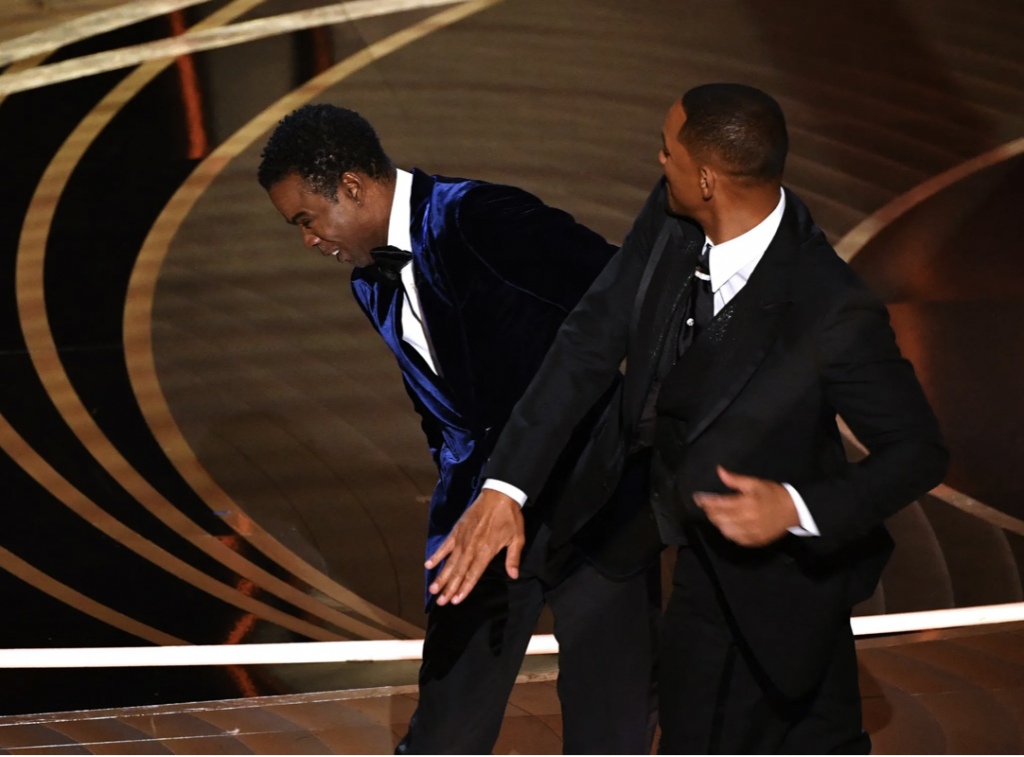
Will Smith should have asked himself how Richard Williams would have responded to an offensive joke before he marched on stage at the Academy Awards and whacked Chris Rock across the chops. If we are to believe King Richard, for which Smith won the Best Actor award, Williams simply stared down every setback, every insult, every act of petty racism that he encountered. In the movie Williams comes across as a monomaniac who never let anyone wear him down. Smith allowed his anger to take control, with catastrophic results.
With one slap Smith showed the world that it’s OK to respond violently to a perceived provocation. It’s a great message to be sending to a country in which millions of nitwits now seem to believe that a violent overthrow of a democratically elected government is justified. These people seem to think that every time a Democrat is elected it’s a crime and an outrage. In Smith’s case the deed also feeds into the racist belief that black people are somehow more violent, more dangerous and crime prone than whites.
Although the practice of ‘roasting’ the nominees is puerile in the extreme, it’s also utterly forgettable. It’s no excuse that Smith was “standing up for his wife” because there’s nothing clever or noble about responding to a cutting remark with an act of brute force, followed up by an expletive-riddled rant. If Smith had wanted to score a point he should have alluded to the presenter’s own lamentable CV. Name a movie, let alone a good movie, starring Chris Rock.
It’s a truism that actors always seem to be acting, even in their private lives. Smith reversed the equation when he showed himself incapable of playing a role on the night of his greatest career triumph. It would have been better for everyone if the Academy had given the award to Benedict Cumberbatch, who had a much more demanding task in The Power of the Dog. While Smith was as good as I’ve ever seen him in King Richard, he played a stubborn, inflexible character. It was like strumming a guitar as opposed to playing a sonata.
As you can see from my Academy Award predictions I was completely wrong about almost everything, except Jane Campion getting Best Director. I can’t say I’m crestfallen, because I was following my own instincts rather than trying to second guess what the Academy might do. There have been many occasions in the past when the best film or best actor didn’t walk away with the prize. Was Rocky really a better movie than Taxi Driver or Network in 1976? Was Kramer vs. Kramer a better movie than Apocalypse Now in 1979?
Jessica Chastain was probably a deserving winner for her performance in The Eyes of Tammy Faye, but the film itself is a dud – a glorified telemovie than lumbers along for too long, too predictably. Can one be a great actor in a film that fails? It’s like Adorno’s question as to whether one can be a success in a society that’s a failure.
The most reprehensible decision was awarding CODA the Oscar for Best Picture. This was a horribly soft option in a field that included at least four excellent movies: The Power of the Dog, Belfast, Licorice Pizza and Drive My Car; and a very slick one in West Side Story. It reaffirmed the culture-bound nature of the Academy, long after Parasite had apparently blown the doors off. As a remake of a French box office smash, CODA was an Americanisation of a tried & true formula. It was a feel-good, coming-of-age movie like a thousand others, the only difference being that it featured deaf people. Was this sympathetic treatment of disability enough to lift the movie out of its comfortable mediocrity? A thousand times ‘No!’.
As CODA was only viewable on Apple TV, it represents another victory for on-line streaming over the cinema. Instead of going to the movies to see the Academy Award choices now one must have subscriptions to Netflix, Stan, Foxtel Plus, Amazon Prime, Apple TV… and on and on. All this is exacerbating the growing divide between blockbuster franchise movies by the big Hollywood studios, which attract audiences to the big screen, and the so-called quality films that have been handed over to the steaming services. The Oscars will eventually be nothing but an annual award for on-line productions, while somebody will come up with a wildly popular new set of awards for blockbusters in which all the prizes go to Spider Man, James Bond or Star Wars.
I was bamboozled last week by the Herald’s presentation of the Adelaide Biennial piece, which featured the late Hossein Valamanesh in the headline and the photo. At first glance I took it for the obituary I’d written on Hossein. I don’t begrudge him the attention, but I do believe the main focus should have been on the show. Anyway, the piece is up on the site now, along with a new column that originates from some reflections on the movie, The Duke.
I was originally asked to do a piece on art heists, but when I looked into the topic there are umpteen websites listing all the greatest hits, and I was hestitant to use precious column space repeating information that is already easliy accessible. Instead, I’ve written an essay that looks at the events of the film and discusses the way atttudes to art have changed, beyond recognition, since the early 1960s. It’s more an examination of contemporary art rather than an analysis of the movie, or art heists in general.
This week the Herald has finally published a cutdown version of the piece I wrote on the NGA’s Gender Equity Plan, so I’m able to put the full-length essay up as a blog. The newspaper cuts, which I’m assured were made for reasons of space, meant that any discussion of the ABC TV documentary, The Exhibitionists, was removed. I’ve left these criticisms intact, as I’m more and more concerned at the second-rate stuff that gets funded and shown largely because it sends the correct political message. It begs the questions: “What doesn’t get shown or funded? And why?”
Some of you may be saying: “He’s got no right to talk! This newsletter is nothing but political raves week after week.” Well yes, but the newsletter is more like a personal journal that I foolishly choose to share, rather than a public statement, and it’s completely self-funded. I’ll never be an “influencer”.
Finally, the film column returns to post-Oscars normality, with Dog – a movie about a man and his dog, who both appear to be suffering from PTSD. It’s not your typical dog movie, but anything with a dog – be it a film, a painting, a sculpture or a novel – will always win hearts and minds. It’s easy to see why. Dogs are so much easier to understand than human beings.