




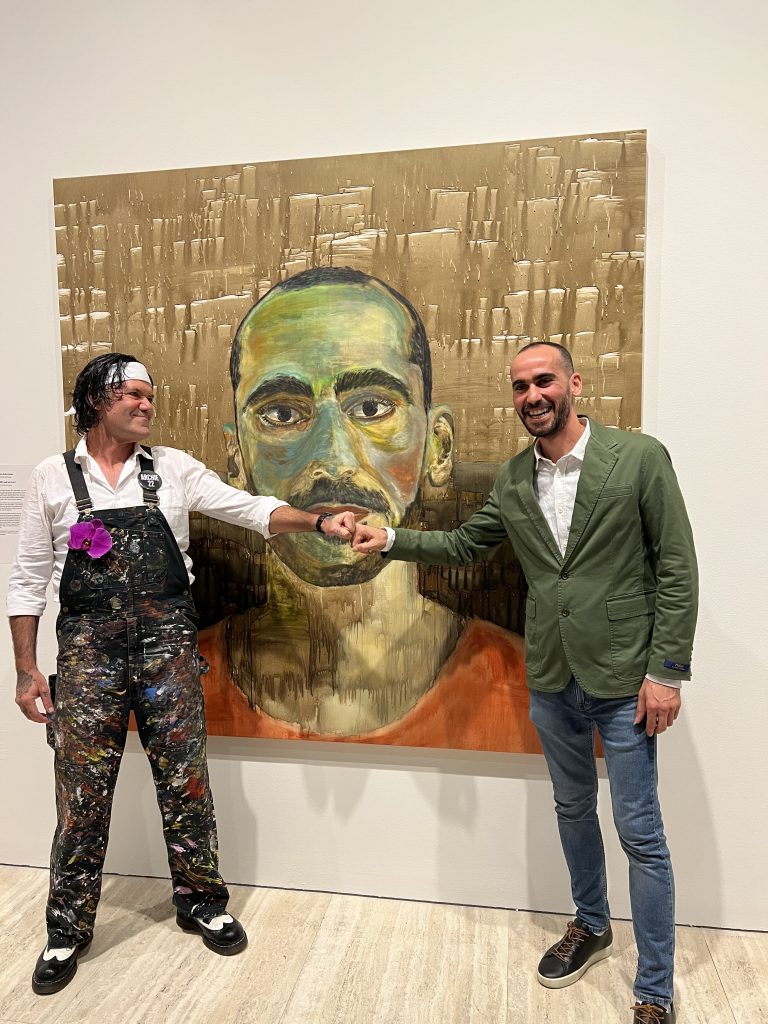
Late again this week, thanks to a few hectic days in Melbourne followed by one whole day devoted to the Archibald Prize hoopla. I’m getting a lot of feedback about the frequency or infrequency of art columns in the weekend paper, but it’s something over which I have no control. All I can do is see what transpires every Saturday and leave the agreed gap before I print the piece on my own website.
The fundamental nature of a newspaper column is that it can be relied upon to appear, week after week, to satisfy those readers who follow it – either to approve or disapprove. When that regularity is interrupted it creates a sense of disruption that is felt in more than one quarter. Like all newspapers the Herald has been hit by declining advertising revenues and the steepling costs of newsprint. Like all newspapers, the on-line version now seems to take precedence over the version one buys at the newsagent.
The on-line ascendency is apparent in the truly ghastly headlines given to many of the columns, which are intended primarily as click-bait. It doesn’t inspire much confidence to see the variations every week depending on what anonymous person is setting up the page. I don’t know why the column is sometimes called “opinion”. All criticism, by definition, is opinion. I don’t know why my byline keeps chopping and changing, although it seems to have settled on: “JMcD is an art critic for the SMH”. Don’t ask me to name the other ones.
I could go on and on with more specific criticisms, but there’s little point in indulging this irritation any further. I’m hopeful that some semblance of consistency will soon be restored. Fingers crossed.
The big art event of the week, needless to say, was the Archibald Prize, which went exactly as predicted, to Blak Douglas for his portrait of Karla Dickens. What wasn’t so predictable were the outspoken political comments the winner made, telling everyone to vote for Albo! Aside from being pretty funny, at least from my point of view, it gave me a lead for a quickfire response in the SMH, which I’m reproducing this week. I’ll be able to write a longer Archibald piece within a week or two, or so I’m assuming…
I’m also posting a piece on Shakespeare to Winehouse: Icons from the National Portrait Gallery, London, at the NPG in Canberra. Aside from being given a title that made me want to throw up (Sure, the Archibalds (sic) are fun, but here’s a portrait show you shouldn’t miss), the SMH version was cut in a surprising manner. Not only were adjectives altered, the edit removed all criticisms of the catalogue, which was a poor addition to a very good show. This made the piece sound completely one-sided – more of a rave than I had intended, with a tacked-on ending that I would never have written. As a result, I’ve reworked the original to make it closer to what I actually wrote (while taking into account the fact that a lot of people have already read the bowdlerised piece) and am zapping you straight to my page, not the SMH page.
The film column this week looks at To Chiara, an unusual crime drama, as seen through the eyes of a 15-year-old girl in a town in southern Calabria. It’s not the most action-packed movie you’ll see this year, but it’s quietly absorbing.
As an extra, and by request, I’m adding some remarks on the late Peter Powditch, which were delivered at the opening of his memorial exhibition at Defiance Gallery on 7 May. I haven’t reworked the piece to make it sound like an essay rather than a speech, but it probably still sounds a bit essay-like.
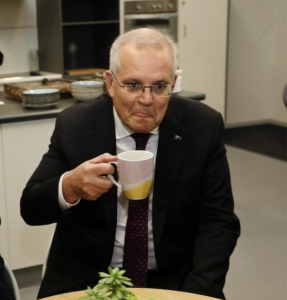
By this time next week we’ll be at the polls, hopefully putting an end to the Age of Scummo – who has promised not to be a “bulldozer” if he’s re-elected. It seems though, his promise is dependent on the next term being a time of free-flowing Milk and Honey, which seems unlikely. Besides, he already claims we’ve been living in a paradise under his enlightened leadership, so I can’t see the bulldozer going back into the garage soon.
There’s a lot I could say to indulge my prejudices one last time before the election, but time is brief, newsletters are too long, and if I got started there’d be no end to it. So instead, I’ll leave you with one photo of our Great Leader, that shows the way his noble visage might be remembered by future generations.