




I’ve finally managed to leave these shores, albeit briefly. Last week I spent two solid days in Singapore, feeling like everything was on the verge of returning to normal, as governments proceed with indecent haste to roll back COVID-19 restrictions. After three years of self-isolation, masks and general paranoia, are we finished with the pandemic? I doubt it.
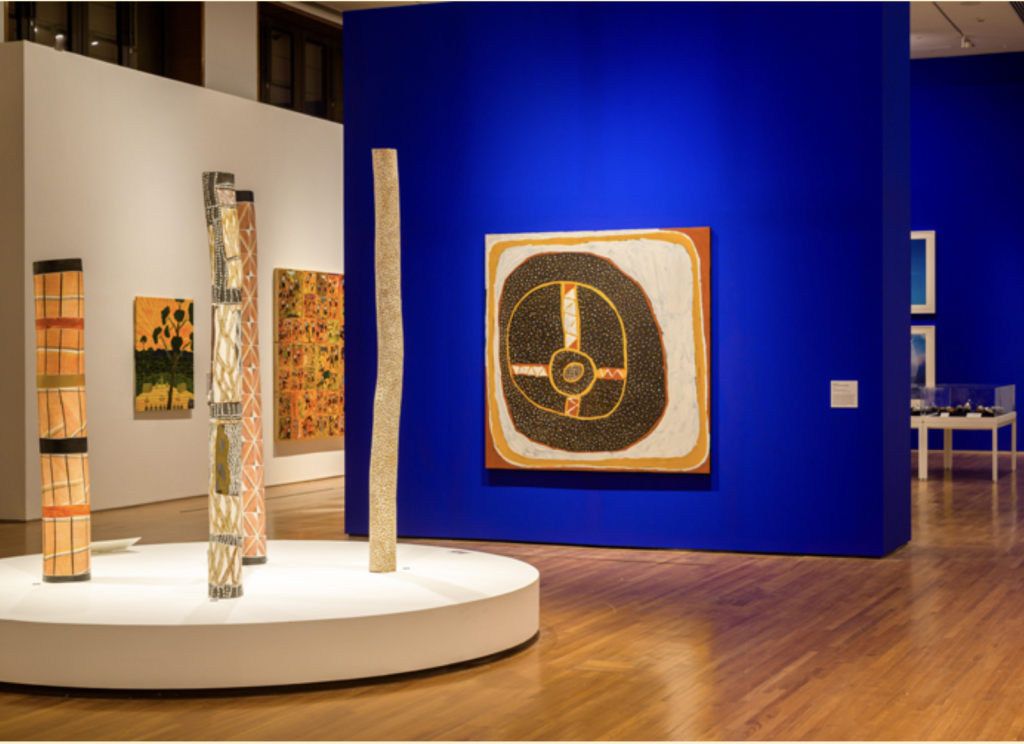
The reason for my journey was to catch Ever Present, a large survey of Aboriginal art at the National Gallery, Singapore, put together by the National Gallery of Australia and Wesfarmers. This collaboration between public and corporate collections may be the start of something. As we live in a world in which museums try and act like big business, and big business likes to flaunt its cultural credentials, it’s likely there’ll many more opportunities for such joint projects.
It would be interesting to compare Ever Present in Singapore to some of the other major indigenous touring shows of the past such as Dreamings, which went to the Asia Society in New York in 1988; and Aratjara (Dusseldorf, London & Copenhagen 1993-94). One might compare the way these exhibitions were received in different parts of the world in different eras, and the way they were conceived by their respective curators.
I recently saw someone refer to Dreamings, organised by anthropologist, Peter Sutton, as the “notorious Dreamings exhibition.” This is something I simply don’t understand. Why was the show notorious? Whatever its supposed shortcomings by today’s standards, it was a groundbreaking project that insisted on Aboriginal works being recognised as art, not items of material culture.
Aratjara was equally radical in its insistence on the aesthetic importance of Indigenous work, and its inclusion of a range of “urban Aboriginal” art, as it was known in those days. In comparison, Ever Present feels like a show that has nothing to prove but everything to assert. The fact that every artist must now have their tribal affiliations mentioned with their name (even Destiny Deacon is “G’ua G’ua/Erub/Mer artist Destiny Deacon”), and every Australian city given an Aboriginal title, represents an advance in protocol, not scholarship.
From being a bold inclusion in 1993, the “urban” work was allowed to dominate the Singapore show, to the point of crowding out many historically important artists. The curatorial voice was in the first person plural – “we”, as opposed to the objective third person that has been a long-standing convention for museum labels and catalogue entries. To me it felt jarring, amateurish, and perhaps a little smug – as if an assertion of shared identity were more important than the advancement of the audience’s knowledge.
In brief, I was left wondering if we’ve made much genuine progress in the way Aboriginal art has been packaged and presented to the world. The rhetoric has become more aggressive, but everything else felt rather shallow. I’ve touched on this in the art column, although I didn’t want to dwell on the negatives when the very existence of this exhibition in Singapore is an important event.
This week’s movie is The Quiet Girl, the only gaelic language feature I’ve ever reviewed. It’s not just the lead character who is “quiet”, the entire film is filled with people who speak grudgingly, when at all. The story is slow to take off, but gradually draws one in, mainly through small details of staging and cinematography. By the end I can’t imagine anyone feeling indifferent – the film is still lingering in my mind.
The action is set in 1981, a tumultuous year in Ireland, with Bobby Sands and other hunger strikers dying for their cause. None of this features in The Quiet Girl, which remains fixated on the life of one small child. It’s amazing how a tightly focused, personal story can be more affecting than all the grand political gestures that artists, curators and filmmakers find so crushingly important. It’s worth remembering that identity is not just an ideological category, but an intimate state, different for every individual.