




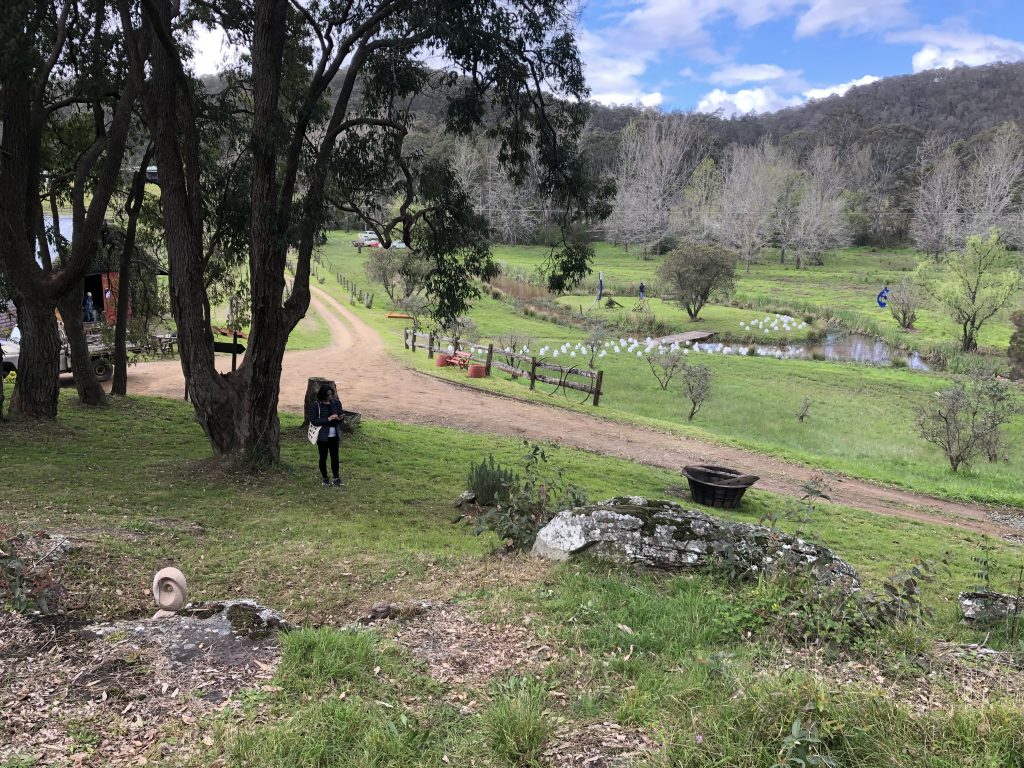
While Sydney Contemporary was drawing the crowds at Carriageworks on the weekend, I was in Wollombi, two hours drive north of Sydney, judging Sculpture in the Vineyards. It’s surprising to realise this event has been going for 20 years, although the past two or three have witnessed a big scaling up of operations. The growth of the sculpture competition has coincided with the steady rise of Wollombi as place that cares about things such as culture and heritage.
For someone like me, who comes from Cessnock, a mere 30 kms down the road, it feels remarkable that anything can escape the all-encompassing philistinism so characteristic of the region. Wollombi’s rise shows that change is possible, albeit led by well-heeled refugees from Sydney, drawn by the natural beauty of the place. Wollombi, as a village, is a huge contrast with Cessnock, a vast sprawling municipality in whch working class sympathies formerly welded to the Labor Party, have been gradually drifting towards the Nationals and One Nation. Although there hasn’t been a piece of coal dug up in Cesnock for decades, the city still likes to think of itself as a coal mining town, as if there’s any romance in this dirty industry.
My background reading for the Weekend was possibly the only novel ever written about Cessnock – The Earth Cries Out (1950), by Harold C. Wells, the former Chairman of the local branch of the Communist Party, who broke with his comrades over ideological differences. Wells’s (literally) gritty social realist novel is set in the early decades of the 20th century, and tells a desperate story of the life of the miners. There’s nothing to feel nostalgic about with this profession.
Altogether, there’s a lot more to be said for the Wollombi lifestyle, which may be sampled until 25 September, when the sculpture festival winds up.
The Herald is finally running the Singapore piece this week, and getting ready to run a column about Vivienne Binns’s show at the Museum of Contemporary Art up on-line. I’m not really able to run it right away, much as I’d like to. Instead, I’m posting a couple of auction catalogue essays on Jeffrey Smart and Brett Whiteley, written for the recent Deutscher and Hackett sale. There was a fair bit of research and writing involved, so it would be a shame not to give them a run, although I tend to let a lot of extra material go by in the course of a year.
This week’s film review is a double-header, looking at the fatuous new George Clooney – Julia Roberts vehicle, Ticket to Paradise. There’s not a lot I can say in praise of this shameless piece of fairy floss, which couldn’t be more of a product if it came shrink-wrapped with a bar code. The other film is Brett Morgen’s David Bowie documentary, Moonage Daydream, which is a whole lot more engaging. Is there anybody in the world of rock music today who is one tenth as imaginative as David Bowie? This film, which dispenses with all the usual apparatus of the documentary and gives us two and a bit hours of immersive footage, makes a convincing case for the singer’s importance. This is achieved partly by ignoring all the dull, pretentious, awkward bits and concentrating on the best aspects. Nevertheless, Bowie at his best was so much better than almost anything else, it would be churlish to dwell on the failures. Just think of him as the Sidney Nolan of glam rock.