




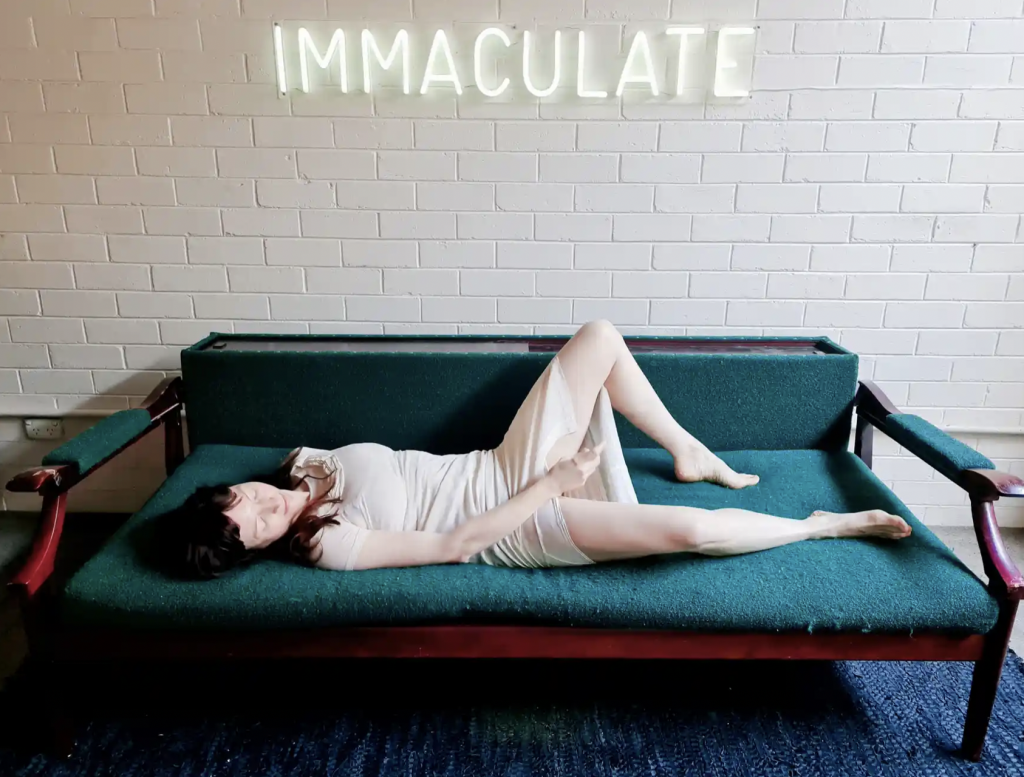
I’m back in Singapore today, for the 7th Singapore Biennale, which goes under the peculiar name of Natasha. I’ll have more to say about this show at a later date, but in the meantme, I was struck by a story in The Age, about Melbourne artist, Casey Jenkins, who is suing the Australia Council “for discrimination in a case that encompasses damages, defamation and breach of contract,” after it withdrew a grant of $25,000 awarded for a 2020 project called Immaculate. This involved the artist injecting herself with sperm from an anonymous donor to conceive a baby.
Jenkins, by the way, is one of those completely non-pretentious people who insist on being called “they”, but as I can’t conceive of an individual – male, female, gay, trans or whatever – as a grammatical plural (themself? themselves?) I shall note the pronoun preference and proceed in a more traditional manner, presuming that anyone who is seeking to get pregnant, even for artistic purposes, most likely began life as a “she”.
Jenkins’s rationale for the project was to “elevate the experience of queer reproduction and disrupt heteronormative parenting narratives.” Somebody at the Australia Council obviously thought this was a cool reason for bringing a new life into this world. Media commentators such as Peta Credlin, predictably thought otherwise, and said so. When the grant was withdrawn there was an immediate suspicion the Oz Co had caved to pressure from the Murdoch crew.
I’m no fan of Peta Credlin, but I can’t help thinking the real problem began when the Australia Council approved the money in the first place. Firstly, no-one seems to have known that Xiao Lu had already attempted a similar piece called Sperm in 2006. When she failed to get any donations, the work was left as a refridgerator, a rack of empty bottles and a video. It is now part of the White Rabbit Collection in Sydney.
Secondly, it’s foolish to believe that anything and everything can be art. We need to draw ethical boundaries around life and death issues. An artist can’t murder or molest another person and claim it was an avant-garde performance work, and neither should “they” be encouraged to conceive a child as art. Even if it’s legal, it’s awful to think what it might do to a person’s mind to know he, she or they were conceived as “art” (let alone as a device for “elevating the experience of queer reproduction”) courtesy of an anonymous sperm donor. There is also the possibility that the child might suffer from a deformity or inherited condition, opening the door to possible litigation as a court tries to determine who is ultimately responsible, and who should pay. Even if Jenkins has arranged all the legal paperwork with such scenarios in mind, she seems happy to think of the child as an object rather than a subject.
I’d argue that the Australia Council was right to withdraw funding from this narcissistic project, but they were completely wrong to fund it in the first place. Nevertheless, as the law is an ass, Jenkins may well have a case. It’s a sad day when an artist involves lawyers in a dispute over a grant. Arts funding is a lottery, not a legal right, and if artists start suing finding bodies when they don’t get a grant, or have one withdrawn, we are on a slippery slope. At the very least, it’s unlikely Casey Jenkins will be receiving any more taxpayer-funded handouts, no matter how provocative the proposal.
When I think of the small-mindedness of so much identity politics, and the ghastly sense of entitlement and victimhood that surrounds such obsessions, my admiration for an artist such as Richard Mosse, who deals with genuinely big issues, is redoubled. This week’s art column looks at Mosse’s incredible film, Broken Spectre, which is screening at the National Gallery of Victoria until next April.
It’s the result of three years of gruelling work in the Amazon, as Mosse and his collaborators tracked the destruction of the rainforest, and all the consequences that follow, from the dispossession of Indigenous people to worldwide climate apocalypse. The film is not didactic, but one walks away feeling flattened by what is revealed. The unique aspect is that Broken Spectre is also a remarkable work of art that uses bright, unnatural colour, innovative cinematography and sound, to create an effect that imprints itself on the mind of the viewer.
The movie being reviewed is Dominik Moll’s The Night of the 12th, which tells us, straight away, that it’s the story of an unsolved murder. Having established that fact, the film proceeds like any other whodunnit, but the tension comes from our gradual acquaintance with the facts of the case and the suspects, not to mention the tortured psychology of the two cops trying to bring the killer to justice. One gets a greater sense of the fragility and mystery of life than anything one might find in a Casey Jenkins project.