




It’s been a busy week, as usual, with a “buried” report on the Powerhouse Museum being revealed, that basically recommends against the proposed $500 million vandalism that is still being ruthlesssly pushed forward in the hope that the new Labor government will find it all too hard to stop. That’s exactly what has happened with Sydney’s suburban bus lines, which have been tied up in billions of dollars worth of private contracts by the outgoing government, making it a costly business to fix a problem that helped turned the western suburbs against the Coalition.
Labor came to power with a promise to fix the PHM mess and to keep the Ultimo site as a museum – which means: not another contemporary art and fashion depot with a “decolonising” agenda. If new ministers such as John Graham (Arts, Tourism) and Penny Sharpe (Heritage) do not act swiftly there will be nothing left to save. At the very least, the plans to completely rebuild the Ultimo site – for a net loss of half the exhibition space – must be frozen. Neither should the PHM be allowed to push through with a scheme to send the curators to Castle Hill and Parramatta, which is little more than a way of forcing out long-serving members of staff so they may be replaced with young, fresh faces who are completely on-message. It’s a way of annihilating an institutional culture that is already looking tattered and torn.
Labor has virtually admitted that the Parramatta development could hardly be called a museum at all, and should not be aligned with the Powerhouse. Therefore it seems a pre-emptive move for the PHM bosses to start relocating curators to Parramatta when there isn’t even a completed building. As the PHM has already officially lost its “M” (although not in this newsletter!), there’s no excuse for dragging the chain. Even if Labor is not prepared to act without further investigation, there needs to be a freeze imposed on ultra-costly projects of dubious value that will further decimate already-decimated attendances.
In the other big arts scandal of the day, the National Gallery of Australia has announced the panel which will undertake an “independent investigation” into the APY saga, but still seems committed to opening the exhibition, Ngura Pulka, with the same artists, on 3 June. The narrow terms of reference mean the panel will only be able to look into the provenance of specific works earmarked for the show. While I have great respect for lawyer, Shane Simpson, who is the only person I know on this panel, the narrowness of the investigation already tells us what the result is likely to be – especially with only a month before the opening of the exhibition. Never again are we likely to see so much snow in the Central Desert.
Of special concern are two key phrases which are being repeated like mantras. Firstly, “creative control”, a phrase that was fed to Arts Minister, Tony Burke, last week, so he could use it in a press statement. Frankly, the Minister should ditch this term ASAP. It is so hopelessly vague it can mean virtually anything, and fudges the crucial issue of whether anyone else should be painting on a canvas supposedly based on the artist’s Tjukurrpa. A white assistant is in no position to add a waterhole in the corner of a painting for purely aesthetic purposes. This makes a mockery of the idea that these paintings are based on age-old story and ceremony.
A term such as “creative control” suggests there is no difference between Indigenous art and any other form of art sold in the marketplace. At the outer limits it authorises an artist to get someone else to paint an entire work for them. So long as they approve, this could be termed “creative control”. These are weasel words and Tony Burke should avoid them, regardless of whatever advice he may have received. If the art museums have decided to bury their heads in the sand and be complicit in this affair, the government need not follow suit. The story is not going away, and will only get worse, causing pain for everyone in the industry.
The second dodgy claim is that the NGA is chiefly concerned with “the welfare and safety of the artists”. Aside from the fact that an art museum is not in the welfare business, it’s hard to understand how the artists might have their safety endangered by an exposure of questionable practices. Are wealthy collectors going to race to the APY lands and beat them up? Are they going to starve to death if they stop selling paintings momentarily? It could be argued just as easily that by highlighting allegedly exploitative practices, the current controversy works to preserve the artists’ welfare and safety in the long term. Either way, the terminology is alarmist, and should be nipped in the bud.
Instead, I predict we will be hearing endless reiterations of “creative control” and “welfare and safety” over the next few weeks, sounding more hollow with each repetition.
The next flashpoint may not be the NGA, but the Art Gallery of NSW, which has included a sizeable group of APY artists in this year’s Wynne Prize for landscape, showing a cavalier disregard for the accusations raised in the media. Should one of these artists be awarded the prize – which is entirely possible – it will set off another round of explosive articles.
Back in the real world, I’ve had my first look at the Archibald Prize, which is a complete mystery to me this year. I only wish it was a beautiful mystery. I’ll be writing it up for next week.
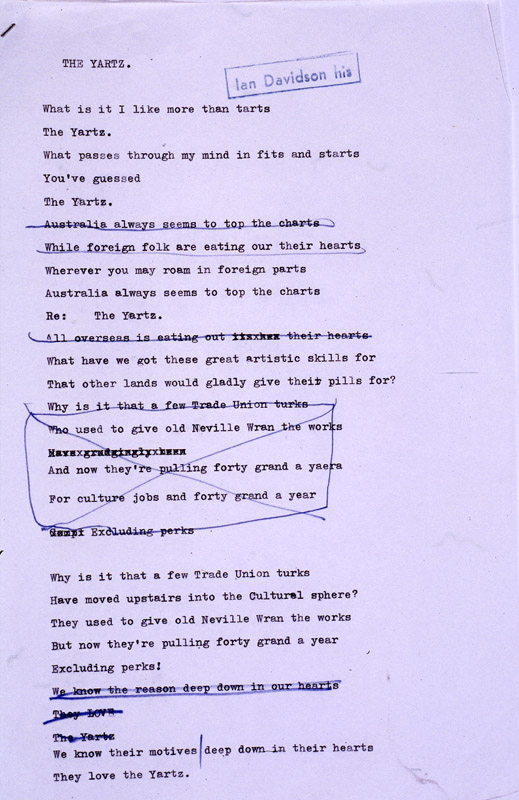
It’s also farewell to Barry Humphries, arguably the greatest comic talent this country has ever produced. It’s sad but predictable that the newspapers have dwelt on Hannah Gadsby’s attacks on Barry. This is old news, and it really shouldn’t be news at all. Quite simply, one of these people was funny, the other is not. Whenever I’ve watched Gadsby speak about art I’ve been struck by the narrowness and narcissism of her approach. Something is missing from any art commentary that can’t get past questions of gender, or an artist’s personality. It’s not an incisive critique of Picasso to say: “I hate him”.
Barry Humphries was the first to admit his own flaws, but his satirical brilliance never faltered. A lover of rare books and Symbolist paintings, he had a cultural depth that informed his comedy. One can’t say Barry wasn’t funny, only that some people didn’t find him funny. Then again, some people have no sense of humour.
This week’s art column finds me in a mad dash to write up the Art Gallery of South Australia’s Andy Warhol and Photography show before it goes off. I’ve never been much of a Warhol fan, but this is a really well planned and executed exhibition. The fact that it’s about an internationally famous artist is a rare achievement in this country – all of which makes it disappointing that the AGSA has allotted it such a brief run and declined to publish a catalogue. It’s uncharacteristic of this institution, and undoubtedly a faux pas. No matter how much it might have cost to do a catalogue, the investment would have been rapidly recouped by local and overseas sales. All praise for the show, but a big cross for the short-sightedness of management. As plenty of catalogues have been published when a show is over (it was common practice during the early years of the MCA!) it’s still not too late to repair the ommision. The AGSA should follow Nike’s advice and Just Do It.
This week’s movie is Polite Society, a truly bizarre, riotous, Anglo-Pakistani, coming-of-age action comedy. I wasn’t sure this would be my kind of film, but it’s irresistible. Such movies are usually mawkish in their sentimental family values, but Nida Manzoor has turned all this on its head. It’s not exactly a profound statement, but as Barry Humphries’s Sandy Stone would say, a nice night’s entertainment.
An extra piece this week is my introduction to Ludwig Berger’s I by Night and You by Day – a Weimar Republic musical comedy screened at this year’s Cinema Reborn festival at the Randwick Ritz. The film lasted all of two months at the cinema before Hitler came to power in January 1933. Today it’s a fascinating rediscovery.
Cinema Reborn, which screens newly restored versions of classic movies from all over the world, is an annual labour of love for a group of dedicated volunteers. It’s almost a relief to report on a project that doesn’t involve millions of taxpayers’ dollars (athough a few $ would be useful). Even in this world it’s reassuring that there are people who will do something purely for the love of it.