




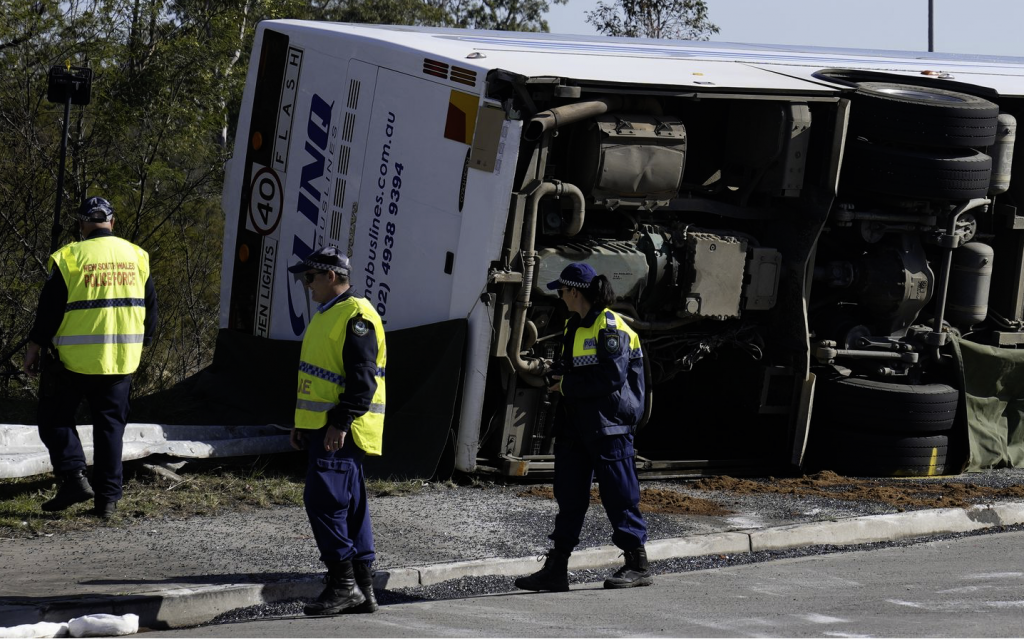
My old home town is in the news again, for the worst of reasons. The bus crash in which ten people died has dominated the headlines. We’ve heard all the predictable stuff about how this a tragedy for a “close-knit community”, the local state and federal members have expressed their horror at the event, sent their condolences and praised the work of the emergency services. However, if we chart where the injured were sent, there are patients in the John Hunter and Mater Calvary hospitals in Newcastle, Maitland Hospital, and the Royal Prince Alfred in Sydney. One would never imagine that the closest hospitals were Cesnock and Kurri Kurri.
Now that the local politicians have made their heartfelt statements, they should take this as a wake-up call to do something about a healthcare system that is widely regarded as a joke and a scandal. Cessnock is one of the fastest growing areas in NSW, but the local hospital – where I was born – no longer has a maternity ward, and (believe it or not) there are many occasions when there are no doctors in residence. There are stories of women giving birth by the side of the road, as they have no chance of making it from say, Wollombi, to Maitland – a drive which takes an hour. This time is crucial, not just to expectant mothers but to stroke victims, and those who have suffered serious life-threatening injuries.
Like many other people, I’ve watched members of my family treated shabbily by local health care “professionals”. It seems that everyone in Cessnock has their own family horror stories.
Not only are Cessnock and Kurri Kurri hospitals no better than dormitories, with the most limited resources for medical care, the new, showpiece Maitland hospital at Metford, has kept the same disastrous staffing ratios as the old Maitland hospital. This means that nurses might expect to be looking after as many as 16 patients. Inevitably the quality of care suffers. People complain of long waiting times in outpatients and other departments.
Only two years ago, veteran journalists, Liz Hayes and Jamelle Welles spoke out at a parliamentary inquiry, criticising the state of country hospital care that had been applied to their late fathers. One would hope their respective employers, Channel Nine and the ABC, would have the wherewithal to revisit this story in light of a bus crash that yet again exposes the debacle of Hunter Valley health care. Labor holds both state and federal seats with two mightily unimpressive members who need to focus on this ongoing disgrace. It’s up to the media and the public to overcome their complancency and force action.
Dreary new housing estates are popping up everywhere in Cessnock, but one cannot expect to enjoy the economic benefits of growth without providing basic health and education infrastructure. It’s easy to strike tragic attitudes about a sudden, terrible accident, but the hospital system is an ongoing disaster that has killed and harmed a much larger group of people, and has the capacity to do a lot more damage. It’s part of the politician’s role to be a professional consoler, but a local member needs to pursue policies that respond to community needs. Until Labor gets its act together in the Hunter, it has nothing to boast about, and no reason to expect loyalty at the ballot box.
The art column this week was intended to present a more cheerful spectacle, namely Bonnard (designed by India Mahdavi) at the National Gallery of Victoria. My first impressions – like everybody else’s! – set off a set of alarm bells upon entering the show, but once you get into the spirit of the hang it just keeps getting better. After two long looks, I’m now trying to remember when I enjoyed a show so much.
Bonnard has always been a special artist for me, and for a lot of painters. This unorthodox exhibition design brings a new dimension to his work.
Alas, here’s the punch-line. I’m not running the review this week because the Herald chose to hold the column without informing me, which means I waited in vain for it to appear on-line. Need I say more? Hopefully it will run next week, but I’m not making any rash predictions.
Back home I’ve been trying to catch as much as I can of the Sydney Film Festival, although I’ve missed many of the high profile movies. I didn’t get to opening night, for instance, but made an effort to see the Warwick Thornton film, The New Boy, at its second screening. It’s the subject of this week’s film review, although it didn’t inspire the same enthusiasm as the Bonnard.
This week I’ve also included two more auction catalogue essays, on John Olsen and Jefrey Smart, and a eulogy on Bob Edwards – one of the most influential figures in the Australian museum world over the course of at least 40 years. For most of that time Bob stayed in the shadows, making things happen while allowing others to take the credit. It’s only in retrospect that we can see his achievements in their entirety and realise what a force he was – as a leader, a diplomat and a strategist. These are very rare qualities in today’s museum world. Even rarer was Bob’s genuine feeling for the public good. If the politicians had even a fraction of his wisdom and commitment we’d be living in a model society.