




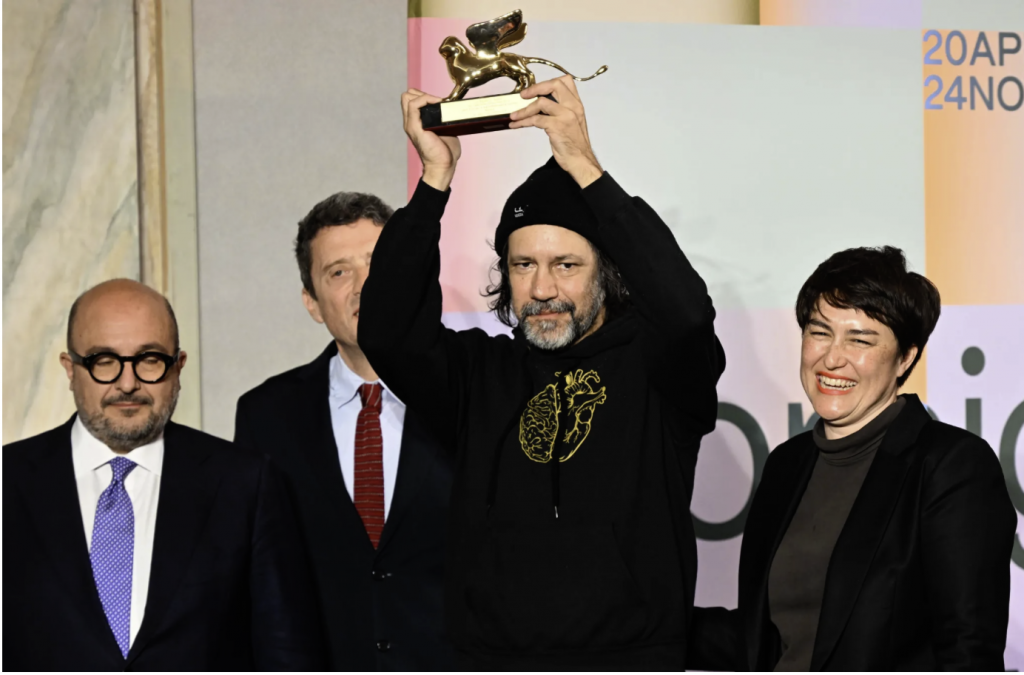
Just when I decide it’s too hard to get to the vernissage of this year’s Venice Biennale, Australia wins the Golden Lion! It came as a surprise, but it’s also a great occasion. For once – perhaps the first time ever – we managed to get it right. Archie Moore may have simply beaten down the judges’ resistance with his huge family tree chalked up on the blackboard walls of the Australian pavilion. Having yet to see the work, I can’t make any critical comments, although Moore is an artist who’s never made much of an impression on me in the past. If it was hard to get enthusiastic about his conceptual, repetitive work, it was equally impossible to have a strong negative reaction. Nevertheless, he’s brought home the bacon in Venice.
It’s an extraordinary bounce back for the Aussies after the incongruous display by Marco Fusinato in 2022, when the rest of the world was showing female artists. For some reason, Marco strumming his electric guitar in front of a video of dogs vomiting (and other choice subjects), didn’t really do it for the judges. While it may not have required a tactical genius to figure out that an Indigenous artist might be appropriate this time around, the Australian arts bureaucracy has been so completely wrong-footed with almost every Biennale – classic “island mentality” – that it’s amazing they finally succeeded.
What makes this award even more significant is that it’s one of the few times the pavilion has not been occupied by an artist who shows with Ros Oxley and/or Anna Schwartz. We finally break the Ros & Anna stranglehold, and instant success follows! It’s a fantastic break for Moore’s dealer, Amanda Rowell, whose gallery, The Commercial, is based in unfashionable Marrickville. Could this be the moment Amanda finally does have a commercial ascendency. Will Archie Moore be the Next Big Thing? Will he become a global superstar? Probably not, but there’ll be distinct benefits for artist and dealer from all this exposure.
If I were being strictly realistic about the international contemporary art market, I’d have to say that Archie’s only chance of hitting the big time would be to be sign with one of the Uber galleries such as Gagosian, Pace, David Zwirner, White Cube or Hauser & Wirth. Having spent the past few weeks in and out of art fairs, exhibitions and biennales in different parts of the planet, I can see a certain pattern in the way public galleries are taking their lead from the top dealers.
For instance, When Forms Come Alive – a show of disparate sculptures at the Hayward Gallery, London – is introduced by a sign that thanks a whole raft of dealers for their “generous support”. The extent of this support is not specified but one assumes the dealers were very happy to assist the Hayward to display and promote the artists in their stables. There’s nothing strictly wrong with this, on the surface.
It’s a simple fact nowadays that the dealers have all the money while the public galleries are starved for funds, being told by politicians that they need to raise a large proportion of their own upkeep. It’s completely understandable they would turn to the wealthy dealers. The big question, however, is whether institutions would make a different choice of artists if this private support wasn’t on offer. For individual artists, being on the books of an Uber gallery almost certainly helps one’s chances of being included in exhibitions at public museums and galleries.
The dealers love these shows because they provide intellectual and institutional credibility for their charges, which translates into rising prices and increased sales. It’s a win for everyone! Museums get the assistance they need, dealers get the exposure they crave, and governments are able to make savings from the public purse.
It’s a perfect arrangement for an age of expediency, in which it doesn’t really matter what you show, so long as it fills a gap in the program. The overall effect, or so I’m beginning to believe, is that the quality of exhibitions is suffering. Much of the work I saw in contemporary shows at the Hayward and the Barbican, and to a lesser extent at the Royal Academy, was shallow and derivative, puffed up by the rhetorical bravura of identity politics.
For instance, at the Hayward, a room-sized schematic model of a roller coaster in pink neon, by American artist, E.J. Hill, was accompanied by this explanation: “So much of my life in this body, in a black body, being queer, it isn’t quiet, it’s very loud, aggressive and violent…” So the pink roller-coaster – almost certainly made to specifications in a factory – is a metaphor for being black and queer. If it had been created by a straight white artist, and presented as a symbol of modern life, would it have been a different work? I’ll leave that question hanging.
What’s also striking in this cosy collusion between public institutions and dealers, is that all the political ‘issues’ that have become institutional obsessions, are so easily commercialised by the art market. Being black and queer is no reason to be poor and neglected. Like every other type of artist, many of these self-defined minoritarians create a huge amount of product that is sold to both museums and private collectors who either want us to believe they have a social conscience, or strictly as an investment in a rising market. About six years ago I visited a collector in New York, the foyer of whose brownstone mansion was packed with unwrapped works by African American artists. These, she assured me, were “the latest thing.”
In Australia the market is a bit too small for such full-on collusion, as one can see from the works exhibited in this year’s Adelaide Biennial, which is one of the shows reviewed this week. Guest director, José Da Silva, has made a convincing argument for everything, even if I’d beg to differ in various instances. Anyway, the exhibition has a very positive feeling, which I’m not about to deny.
The other exhibition being reviewed in this catch-up week is Paris – Impressions of Life 1880-1925, at the Bendigo Art Gallery. This show, drawn from the holdings of the Musée Carnvalet, which deals with the history of Paris, is a perfect example of an accumulation of small, quirky items that add up to a fascinating presentation. To go looking for masterpieces would be precisely the wrong way to approach this event. It’s a kaleidoscope of Parisian art, fashion and social history that needs to be enjoyed on its own terms. It’s to the credit of Bendigo that a regional gallery will initiate such a show when state galleries are struggling to host international exhibitions.
There was a log jam of possible and probable movies to be reviewed this week, but I finally settled on Luca Guadagnino’s Challengers, as the best of the mainstream offerings, and Ryûsuke Hamaguchi’s Evil Does Not Exist, as the most significant ‘alternative’ release. Please don’t look for any relationship between the two. Challengers is a sophisticated, fast-moving entertainment, Evil’ is a slow, deep & meaningful affair. There’s still an audience – and a market – both kinds of films, which gives me an optimistic feeling about the contemporary cinema that I’m finding it hard to sustain in relation to the contemporary art world.