




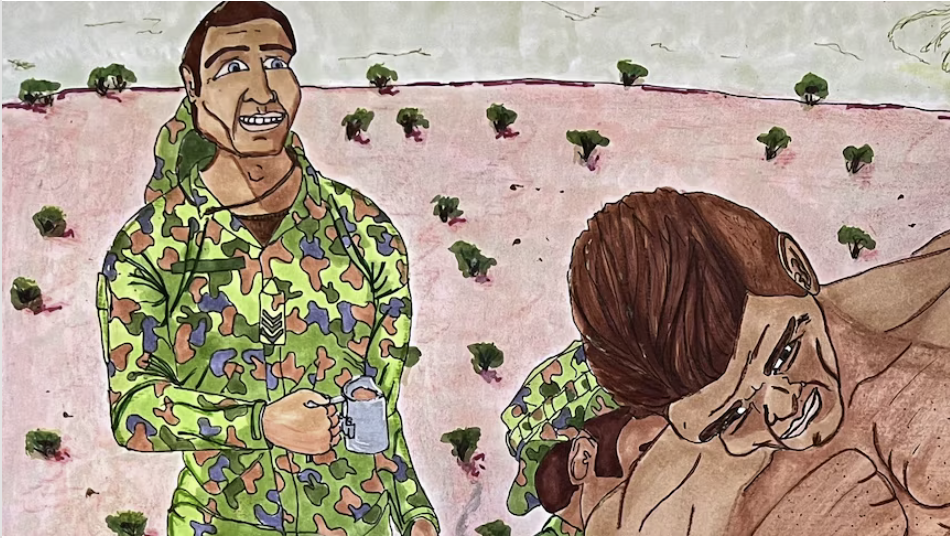
Whenever the visual arts become a source of controversy or scandal I can expect calls from radio stations and newspapers around Australia. Needless to say, Gina Rinehart’s complaint about the Vincent Namatjira portrait made the phone ran hot. The most recent topic that brought a flurry of calls was Steven Bostock’s entry in the 2024 Napier Waller Art Prize, on display at the Australian War Memorial. Or rather, concealed at the AWM, and on the website. To see the work on-line one needs to negotiate a warning panel which says: “This work of art includes confronting content which some people may find challenging and disturbing… Viewer discretion is recommended.”
Encountering such devices, I imagine the judges congratulating themselves on their broadminded, progressive attitudes. The inevitable result of such a warning is that it makes it irresistible to click on the sign and take a look. What viewer would honestly use their “discretion” not to do so? How could any “discretion” be reasonably brought to bear when it’s not even clear what the picture contains?
What viewers will discover when they look at The impossible sit-up challenge, is a crude coloured drawing that shows a soldier lying down with a blindfold over his eyes, and another who has stripped off and positioned his bare arse over his colleague’s face. Apparently, it’s an example of the kind of hilarious prank soldiers like to play on each other, inspired by the artist’s personal experiences in the army. To give it a name, it’s an example of “hazing” – an act intended to humiliate or degrade a new recruit.
And now the obvious question: “Why did the judges of the Napier Waller Art Prize decide to include this work in the final selection?” Most art prizes discreetly avoid works that may be deemed offensive or provocative, but the AWM, of all places, felt the need to include a picture that shows the very worst aspect of the Armed Services.
The stated mission of the AWM is: ‘To assist Australians to remember, interpret and understand the Australian experience of war and its enduring impact on Australian society’.
As for the Napier Waller Art Prize, it is “open to all current and former service personnel in the Australian Defence Force. The bi-annual prize encourages artistic excellence, promotes the transformative power of creativity, and raises awareness of the experiences and talent of service personnel.”
Without getting too legalistic, it’s hard to see how a picture about hazing helps us understand the experience of war or promotes the transformative power of creativity – unless we believe that army culture must be understood as toxic, and exposed as such by the power of art. The message seems to be: “With comrades like these, who needs enemies?” If this shows the ‘transformative power of creativity’, those most likely to be transformed are people who previously entertained a good opinion of the armed services.
There are no fewer than six judges for the Napier Waller, confirming my firmly held belief that no art prize should have more than three judges. The list includes Matt Anderson, Director of the AWM, and Laura Webster, AWM Head of Art; Bree Pickering, Director of the National Portrait Gallery; Penelope Grist, Director of the Parliament House Art Collections; artist, eX de Medici, and – most incredibly – Angus Campbell, Chief of the Australian Defence Force (!)
What were they thinking?
According to Laura Webster, speaking to the ABC, “The artist has shown quite interesting illustrative talent. It’s a particular perspective of his service, which was important for him and possibly for many others.”
Ah, so it’s Mr. Bostock’s “quite interesting illustrative talent” that caught the judges’ fancy!
My theory is that this “particular perspective” is another manifestation of the growing tendency of galleries, museums and other public institutions, to embrace a historical burden of guilt and shame; to take the blame for the misdeeds of the past – whether it be colonialism, sexism, racism, or the nasty bullying that has long been an unspoken feature of army life. Now it can be told! Now the nation’s flagship war museum, previously devoted to commemorating the sacrifice of lives lost in defence of the country, is ready to step up and show us the really awful stuff that happens in the army. It’s not exactly an encouragement for anyone to join up. Added to media reports of bullying, sexual harrassment and suicide in the ranks, it paints a pretty dismal picture of army life.
Had the judging committee – and it is a committee – decided to choose a work that made the army look bad, they could hardly have made a better choice.
It seems as if the guardians of our cultural institutions have decided that their most important mission is to root out social injustice and historical wrongdoing. By concentrating on works that fulfil this agenda, they can feel wonderfully virtuous. If the general public shows no interest and stays home, that only shows urgently the public needs to be re-educated. In the meantime, government makes up the shortfall, embracing the virtuous attitudes but grumbling about the expense.
Isn’t it time that we restored a sense of equilibrium, accepting that cultural institutions need not repudiate every traditional mission or historical legacy? Recognising that there’s good in the past (and the army), as well as bad? That works of art need not be critical in order to be judged acceptable? I suspect we’ve still got a long way to go before we get through this period of institutional self-flagellation.
In the meantime, this week’s art column looks at Jonathan Yeo’s portrait of King Charles, and other royal portraits. It’s not exactly a review, but more of an essay and an historical overview.
The film being reviewed is the long-awaited Furiosa: A Mad Max Saga. It’s the cinema sensation of the moment, but that enormous sense of expectation fell flat for me on opening night when the film didn’t live up to the high standards Miller set with its predecessor, Fury Road (2015). Furiosa may be a better movie than most of the action flicks that draw crowds on a Saturday night, but it takes the Mad Max story into a dark, brutal place that doesn’t make for exhilarating viewing. Feel free to disagree.