




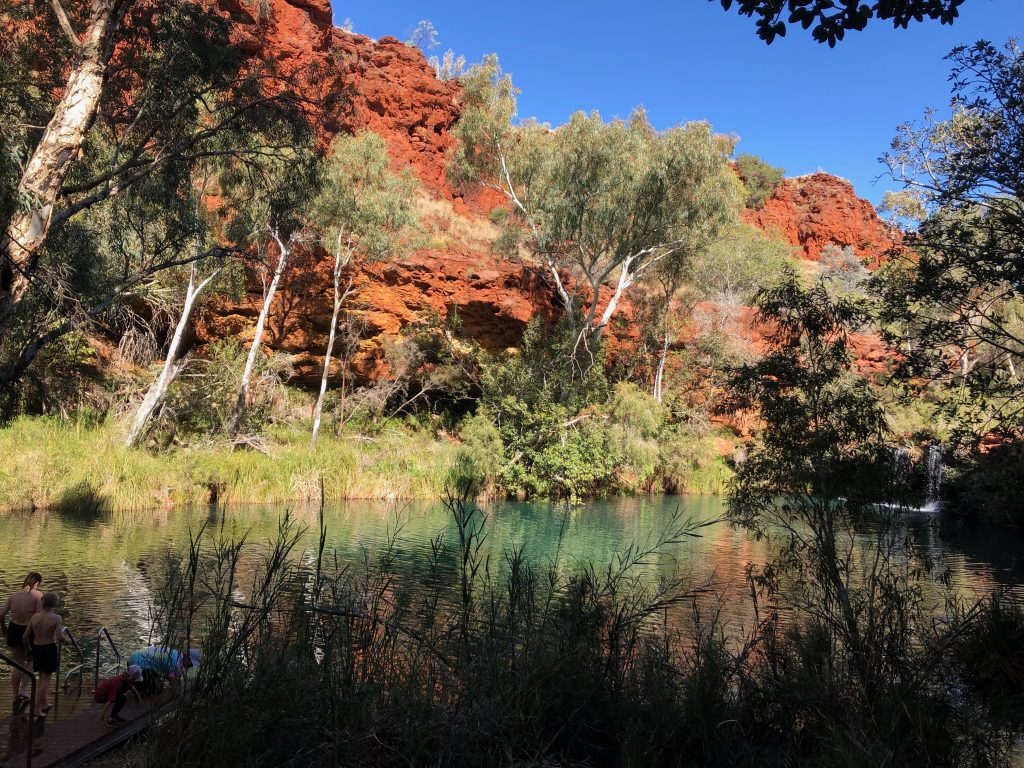
Perhaps I should just stop apologising for the lateness of these postings. Ever since the pandemic restrictions began to ease I’ve been on the road again – this week really on the road, covering roughly a thousand kilometres around the Pilbara. I filed my film review from the Ganalili Centre in Roebourne just before heading off into territory where no WiFi or phone reception existed, (at least for my particular service provider).
The occasion was an invitation from arts agency, Form, which has organised a show called The Tracks We Share at the Art Gallery of WA. A group of journos and curators travelled from Karratha to Newman, and places in-between, to meet artists and the landscapes that inspired their work. This was the kind of trip one doesn’t hesitate to accept because it’s incredibly difficult to visit Indigenous communities solo, let alone get to places such as Karijini National Park, or the Millstream-Chichester National Park.
In retrospect it feels like a very long week, filled with red dust and vistas of ancient mountain ranges, some of them brutally sculpted by the mining industry. What struck me so forcibly about the communities we visited, was the strong sense of morality and social order that prevailed, and the indefatigable willingness to tell stories relating to the local culture. I know this is not the case for all remote communities, with many tales of disaster and dysfunction, but when an Aboriginal group has a set of intelligent, determined leaders it’s as if the entire community is an extended family. This was certainly the case with the Juluwarlu Art Group, with whom we spent a night camping on country.
Camping for me is one of those once-in-a-blue-moon experiences, and I’ve no desire to do it more frequently, but for this week, all bourgeois expectations were suspended.
Having written so much about Indigenous art over the years, I’m still keen to piece together a more precise idea of the communities that produce so much amazing work. If you’ve never been to the source, the art itself must always remain a little mysterious. There can be few artforms anywhere else in the world so deeply reflective of the character of its creators, and of an age-old symbiosis between human beings and the land upon which they live. This may sound grand and romantic but when you’re on the spot it’s the most natural thing in the world.
The art column this week comes from Adelaide where Robert Wilson: Moving Portraits, has just opened at the Art Gallery of South Australia. Wilson may have the most prosaic of names, but he is probably the leading theatre director on the planet. The video portraits are a sideline for this prolific American entrepreneur but one he takes extremely seriously. Adelaide is the only Australian venue, in a double bill with Archie 100, the centenary survey of the Archibald Prize organised last year by the Art Gallery of NSW, but shown only in a pandemic-reduced short season. If you blinked and missed the exhibition in Sydney there’ll be plenty of chances to catch it as it tours Australia.
Ever since his death in 2016 it seems the general public can’t get enough of Leonard Cohen. There have been films, exhibitions and tributes without number. Hallelujah: Leonard Cohen, A Journey, A Song, is the latest documentary devoted to the old Canadian troubador. The filmmakers tell the story of Cohen’s career through a close tracking of a single song which has become an anthem for our times. While it’s touching to watch Cohen’s late concert footage, it’s mind-boggling to realise how Hallelujah has taken on such a range of meanings for so many people. Personally, I’ll never hear it again without thinking of the Ganalili art centre.