




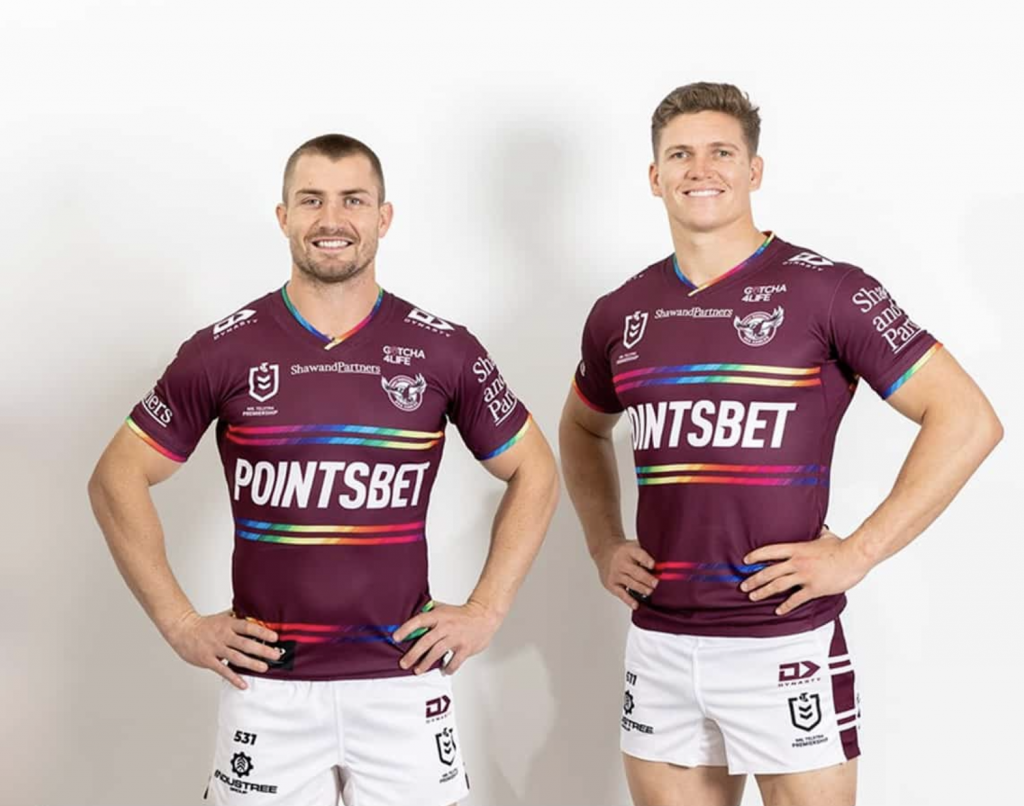
While war rages in the Ukraine, the global economy takes a nose dive, Europe withers in an historic heatwave and new strains of COVID-19 keep popping up everywhere, the big news in Australia was that seven players from the Manly Sea Eagles stood down from a game because they didn’t want to wear a jersey with a gay pride strip.
All week the media has hammered away at this tale, many seeing it as disgraceful that the players – from Pacific Island and Indigenous backgrounds – refused to show solidarity with the LGBTQ cause. Others, perhaps realising that it’s not a good look to blame Indigenous people for anything nowadays, blamed the Christian missionaries who convinced the peoples of the Pacific that homosexuality was a sin.
Try as I might, I simply can’t understand what the managers at Manly were thinking when they came up with this idea and foisted it on the players without consultation. It may indicate great respect for LGBTQ folks, but it showed no respect whatsoever for the contracted players, whose “religious and cultural beliefs” put them in conflict with the plan. Furthermore, it made those players look like homophobes and bigots, when they may have never done a homophobic thing in their lives.
What we see is yet another example of the National Rugby League trying to portray their hulking brutes as shining role models, eager to display enlightened attitudes towards worthy social causes. It’s rather a shame there’s such a steady stream of stories about league players engaging in sexual assault, off-field violence, drug abuse, and various other recreational activities.
When I was growing up in the heart of rugby league country nobody entertained any delusions that the players they cheered every week were also social role models. Those players were there to win footy matches, and it mattered little to the fans if their off-field behaviour was repugnant. You might worship someone as a player but have no desire to have them around for dinner. The players were hired guns, gladiators who represented one country town in its tribal battles against the neighbours. Football was a social safety valve. It was said that if it weren’t for the NSW Rugby League the prisons would have been full to overflowing.
Now we are expected to look back on those dark days, before Rupert Murdoch & co made the game into a multi-million dollar commercial enterprise, and congratulate ourselves on these new caring-and-sharing attitudes. But even though the top players are earning hundreds of thousands of dollars per season, I wonder if they are all that different from those gladiators of yesteryear. There’s just as much violence and aggression, even with a rainbow strip on their jerseys.
It’s those same players that have had to bear the brunt of the outrage when management decided to engage in a blatant public relations stunt that tried to pretend the violence on the field is perfectly compatible with the most socially progressive attitudes. The abiding rationale is that young men who look up to these heroes of league will abandon any homophobic views if they see a gay pride jersey on the back of some musclebound footy star.
By the same logic, will young men become fervent gamblers when they see the massive “Pointsbet” logos plastered all over the Manly players? Surely there’s a contradiction in taking a free ride with LGBTQ issues, while subsisting on the filthy lucre of a gambling company. Today, big organisations such as the NRL seem to have boundless enthusiasm for empty but inexpensive gestures intended to assert their political purity while taking millions from sponsors who promote gambling, boozing, and stuffing one’s face with fast food. (Never was there a more apposite slogan than KFC’s “I don’t care!”) The ideal result might be a generation of obese, alcoholic, problem gamblers with socially progressive views on race and gender.
This week’s art column finds me in Hobart, where I’ve written up the $100,000 Hadley’s Art Prize for landscape, and the new installations at MONA. It’s been at least three years since I was last in Tasmania and it felt good to be back, even if I spent the best part of one day in that dark, sandstone-walled dungeon David Walsh designates a museum.
The film being reviewed is The Forgiven starring Ralph Fiennes and Jessica Chastain as a squabbling couple on their way to a party in the Moroccan desert… when everything goes drastically wrong. I’m afraid Ralph’s character is a bigot and a misanthrope who entertains a lot of politically unacceptable views about everyone who isn’t English. Sensitive Manly fans might like give this one a miss.