




Every month I receive books from authors and artists who hope I can write about their work, bringing it to wider attention. Most of the time, I’m afraid to say, it’s not possible, largely through considerations of time and space. I have severe limitations on both, no matter how well disposed I might be towards a publication.
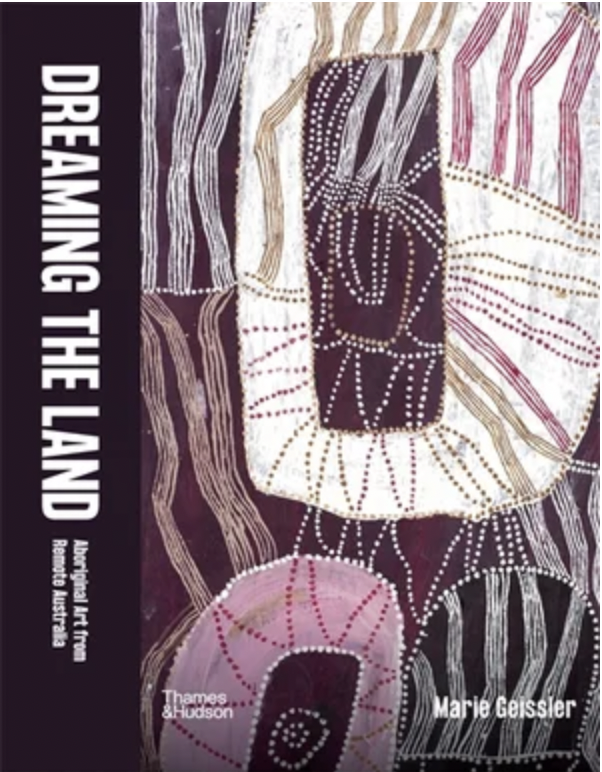
There are, however, exceptions to this loose rule. One is Bernice Murphy and Leon Paroissien’s book on architect, Andrew Andersons, which I’m still perusing and will address on a future occasion; the other is Marie Geissler’s Dreaming the Land: Aboriginal Art from Remote Australia, a massive tome from Thames & Hudson that represents a good ten years’ work.
Geissler has been involved with Aboriginal art for decades in one capacity or another, and this book is a labour of love. One might think it’s a theme that would appeal to reviewers across the media, but she has had trouble getting anyone’s attention. Surely this can’t be because we’re bored with Aboriginal art? The so-called industry has never been more high-profile or well-publicised. The quality of art is sensational, and there is growing international interest and acclaim.
I have a sneaking suspicion that Marie’s biggest problem is that she is not Indigenous herself. One imagines this should not be an obstacle, and few would state the case in such blunt terms, but that doesn’t mean authors or artists or curators are not subject to judgements which have nothing to do with the quality of their work or the sincerity of their commitment.
It hasn’t been an overnight process but there has been a rapid acceleration over the past year or two in the way people are being assessed for their identity – which is largely a matter of fate – instead of their ability or achievements. The fact that so many institutions now require their representatives to list their pronouns (“she/her”, etc), seems to me a piece of corporate idiocy. If the writer is one of the tiny minority of people who want to declare themselves gender fluid or whatever, let them make such declarations. For everybody else it’s foolish tokenism to declare whether you are ‘he’ or ‘she’, when it’s perfectly obvious.
Likewise the new obligation to state the Indigenous “nation” on which you live. For many people this is a confusing requirement. Why, for instance, does “Canberra”, which already seems to be a Aboriginal name, suddenly have to play second fiddle to “Kamberri” ? It may be an inevitable trend, but the speed with which such Indigenous place names have been accepted is quite remarkable, and disconcerting to many. Move too fast and you fail to bring the majority with you, creating divisions that previously did not exist between groups of people who are fundamentally in sympathy with Aboriginal issues.
The worry for me is that such innovations, which are enforced with increasing rigour, are feel-good, low-cost measures that have few real-world ramifications. If it were a matter of paying out millions in reparations to the always-were-always-will-be owners of the land, these practices would cease overnight. One might entertain similar concerns with the idea of the Voice to Parliament, which will soon be the subject of a referendum.
Even though I’ll vote in favour of this measure, I can’t help wondering if an advisory body with no legal power, will be of much use, although it will be a handy job for those selected to sit on the committee. I don’t want to sound like Senator Jacinta Price, who comes across as a pernicious attention-seeker, but with the Voice, I can only keep my fingers crossed that something good will come out of it.
Surely, we should all be prepared to judge artworks and individuals on their merits, and in this scenario Aboriginal art needs no apologists. Geissler’s book begins with three excellent introductions – by the author; by Margo Neale of the National Museum of Australia, and by independent curator, Djon Mundine. It then provides profiles of 100 major artists, charting the evolution of the Aboriginal art movement since its origins in Papunya in 1972. If I say this makes the publication a vauable reference book, I’m not saying anything even remotely controversial. One could quibble over Geissler’s choice of artists but she doesn’t seem to miss any of the major talents. If the book is not well and widely reviewed, this is not an accurate refection of its value.
Speaking of Aboriginal art, this week’s art column looks at Heart of Country, an exceptional show of bark paintings at the S.H. Ervin Gallery. The works are drawn almost exclusively from the private collection of Andrew Dyer and Donna-Marie Kelly, who show what can be achieved when one is sufficiently dedicated and knowledgable. Most of the major artists are represented, from Yirawala toNongirrna Marawili.
The film is another art-related affair – Blaze – the debut feature by Del Kathryn Barton, better known as a contemporary painter. It’s a movie that can be admired, but not exactly liked. The subject is childhood trauma, and we are never allowed to get away from that theme, even allowing for a succession of fantasy scenarios inserted into the narrative. One feels a certain moral pressure to be positive about this film, but not many viewers will leave the cinema feeling exhilarated. How nice it would be to forget about all the things one should like, and allow our spontaneous reactions to reclaim centre stage.