




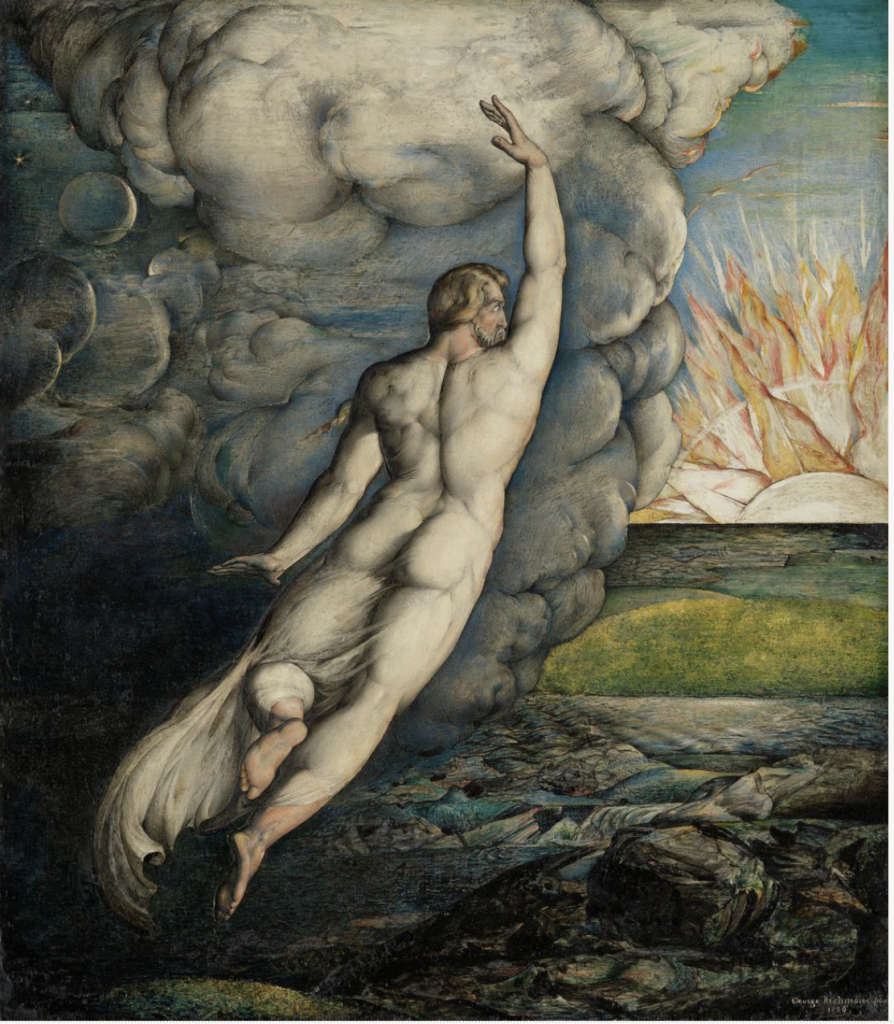
After He created heaven and earth, the next item on God’s list was light. “And God said, Let there be light: and there was light.” Just like flicking a switch.
All artists love to play God, and light is their most fundamental concern. Not only is it hard to make art in the dark, light is crucial to the use of colour, to creating a sense of depth or form, and to any transcendental aspirations the artist might entertain. Even before Genesis.1:3, light was associated metaphorically with the spirit, with truth and purity.
All these readings are to be found in an exhibition at the Australian Centre for the Moving Image in Melbourne, drawn from the holdings of Tate, Great Britain. Light is a unique event for ACMI, in that it consists mainly of paintings rather than films, videos, or new media. The rationale is that the moving image grows out of the traditional forms of visual art, with some of the more spectacular paintings being the obvious forerunners of today’s Hollywood blockbusters.
It’s appropriate that the first work we encounter is George Richmond’s The Creation of Light (1826). A muscular God, dressed in a diaphanous robe that leaves nothing to the imagination, flies though the air like a comic book superhero. With one sweep of His arm He ignites a blaze of light on the horizon. Although the picture is heavily indebted to William Blake and Henry Fuseli, it’s a suitably dynamic introduction to a show that will oscillate between outlandish spectacle and works of a more subtle, quasi-scientific nature.
(1822, restored 2011
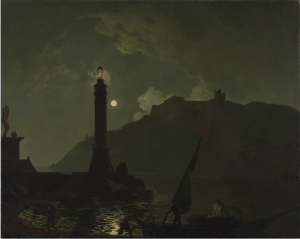
Richmond’s Creation is not the earliest work on display, that distinction belongs to two brilliant nocturnal scenes by Joseph Wright of Derby (1734-97), including an eruption of Vesuvius. Wright is an artist not much seen in Australia, and therefore one of the highlights of this selection.
(exhibited 1843)
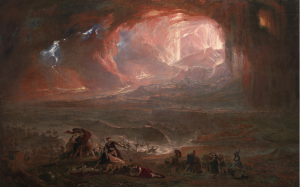
The same might be said about ‘Mad’ John Martin (1789-1854), whose The Destruction of Pompeii and Herculaneum (1822) presents a breathtaking scene of cosmic horror in which the entire sky is lit up with the fierce red glow of the erupting volcano. Clouds of smoke form swirling tunnels in mid-air, while tiny groups of Romans cower helplessly on the other side of a turbulent harbour. This work was a show-stopper when it first appeared, and it’s just as thrilling today, although so far over-the-top, audiences might be inclined to giggle rather than gasp.
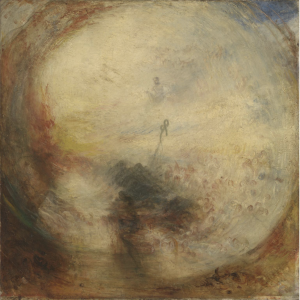
One of the main drawcards is J.M.W. Turner (1775-1851), represented by a selection of the technical drawings he used during his term as the Royal Academy’s Professor of Perspective, and by some important paintings, notably The Deluge (1805), Light and Colour (Goethe’s Theory) – The Morning After the Deluge – Moses Writing the Book of Genesis (exhib. 1843), and The Angel Standing in the Sun (exhib. 1846).
Turner is known for his preoccupation with light and atmosphere, which went so far that many of his contemporaries thought he had lost his wits. In The Deluge, painted when he was barely 30 years old, Turner gives us a highly theatrical account of the world being destroyed by the Biblical flood. The sky is dark and glowering, terrified people cling to whatever they can find as the waves rise ever higher. The late pictures are equally apocalyptic but now the drama is conveyed by the vigorous application of paint. Figures are no more than tiny blurs, caught up in a whirwind of pale pigment. These works, which teeter on the brink of abstraction, are elemental dramas, filled with wind, rain, mist and dazzling light.
We admire these paintings today for the very same reasons Turner’s peers disliked them. What seemed incomprehensible to the mid-19th century, appears revolutionary in retrospect.
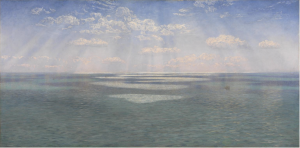
A few decades later, the apocalyptic mood seems to have abated. John Brett’s The British Channel seen from the Dorsetshire Cliffs (1871), is a remarkable piece of proto-Impressionism – a serene, intricate study of sunlight on water, painted by the most atypical of the Pre-Raphaelites. What’s most striking about this picture is its naturalism. Light is no longer being used for high symbolic purposes, threatening humanity with hellfire and damnation. Brett’s method is purely observational. There’s symbolism to be found if we go looking for it, but it seems that Brett’s main inspiration was simply the play of light on water on a sunny day.
This brings us swiftly to the French Impressionists, with works by Monet, Sisley and Pissarro. These are inevitable components of an exhibition devoted to light. It could be argued that Seurat is just as necessary, but the Tate owns only one important painting, and an oil sketch, neither of them included in this show.
Seurat appears as an illustration in the catalogue essay by Kerryn Greenwood from the Tate, along with a few other major paintings that would be included in any definitive show on the theme of light. It’s a kind of fantasy checklist. More confusingly, there are other pieces by artists such as William Blake, John Everett Millais, Henry Wallis and Anish Kapoor, that are given full entries in the catalogue, but not included in the exhibition. One has to turn to the back of the catalogue to find a list of works that are being shown at ACMI, which is messy, to say the least.
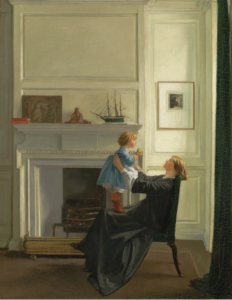
On the plus side, a room devoted to light-filled interiors, with a jazzy floor by Philippe Parreno, features a stunning painting of woman with her back turned to us, by the great Danish artist, Vilhelm Hammershøi; and a mother and child by William Rothenstein, an underrated artist. One wonders if light is a major theme in either picture, but let’s not be too fussy.
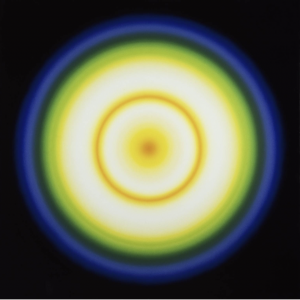
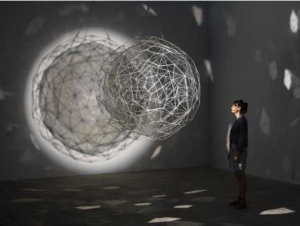
After that we’re into the modernist era and beyond, with works by artists such László Moholy-Nagy, Dan Flavin, Liliane Lijn, and Olafur Eliasson, all obvious inclusions in a light-themed display. There are also pieces by Wassily Kandinsky, Bridget Riley, Yayoi Kusama, and a real crowd-pleaser, in Peter Sedgley’s Colour Cycle III (1970), a kinetic piece that features an ever-changing display of colours on a circular canvas activated by an ingenious light projection.
Aside from the strange disjunction between the display and the catalogue listings, Light suffers from the usual problems of most British touring exhibitions. In brief, the show is conceptualised in a perfunctory manner, with a short, generalised catalogue essay, and a somewhat arbitrary selection of work, incorporating the good and the ordinary. Even some of best pieces, by Turner and Brett, for instance, have been included in earlier touring shows within the past decade.
The positive aspect of this show is that it represents a new departure for ACMI, which has never previously exhibited so many historical paintings. If the theme is so broad to admit almost anything, it doesn’t preclude works of quality. From a selection ranging back more than 200 years there are more than enough highlights to ensure an illuminating experience.
Light: Works from Tate’s Collection
Australian Centre for the Moving Image, Melbourne
16 June – 13 November, 2022
NOT Published @ the Sydney Morning Herald, 11 July, 2022