




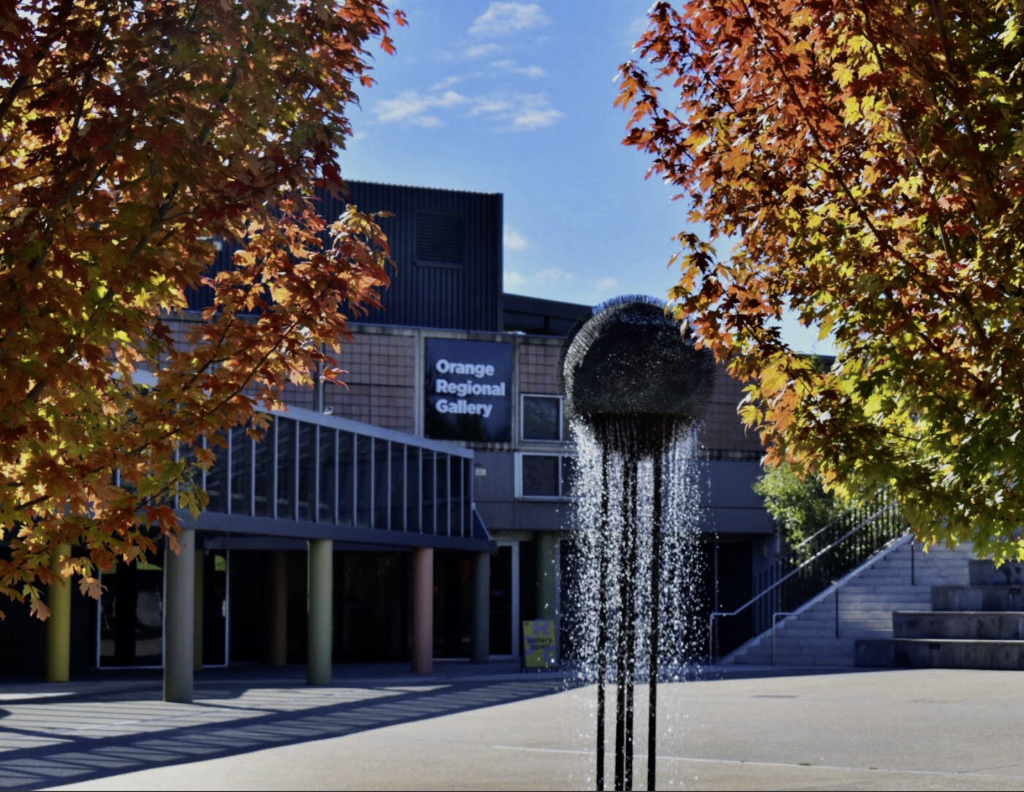
Late again, largely because I drove up to Orange for Laurence Edwards’s show at the Orange Regional Gallery. If I’d stayed in Sydney I probably would have read Revive – the new National Cultural Policy that was released this week and written about it. Even at a glance it’s obvious the policy statement is top heavy on Indigenous culture, as this is universally perceived as an issue of great moral urgency and a sure winner with the arts community. One wonders, though, if the overwhelming concentration on this one area is going to lead to a disparity in the way resources are distributed across the board. I’ll need to read the document rather than speculate, but my suspicion is that money which might be better spent on supporting and developing a range of regional arts bodies will be channelled into Indigenous areas with little consideration of quality or cost effectiveness. On one hand it’s important that Indigenous culture is finally receiving due recognition, but it’s a mark of our immaturity that the thing so long neglected suddenly becomes the only game in town.
I was overdue a trip to Orange to see the city’s newly expanded gallery, and it proved to be tremendously impressive. Remembering the battles fought by previous local directors with some of the small-minded, provincial types that considered themselves notable figures in the arts, I’d have to say that the incumbent, Brad Hammond, has it pretty good. Not only does he preside over a large, state-of-the-art exhibition space, but he has a supportive council and an enthusiastic group of Friends that have raised some serious money for acquisitions. He has responded with a series of artist surveys that demonstrate how much can be achieved with a little initiative and imagination. State galleries, please take note. I’ll save discussion of the Edwards show for another occasion. The revelation of the trip was that Orange appears to have established itself as a rising cultural centre in a way that most other country towns could only envy.
With regional galleries there is always a fragility about what can be done because of the ever-present danger of being saddled with a new council filled with narrow-minded dills who can’t see the point of an art gallery. In Orange there is such a groundswell of popular support – perhaps assisted by refugees from Sydney, or those who lead urban-rural lives – that the gallery seems to have gone past the point where it could all fall apart. Another gallery in NSW secured! Only about 30 more to go.
The other notable event of the week was the Night of Ideas – La Nuit des Idées – sponsored by the French embassy at the Museum of Contemporary Art. This evening of talks, forums, performances, and exhibition tours attracted more than 700 people. What was really exciting was the thought that this was only one of 182 similar evenings held in cities across 115 countries, from Ulan Bator to New York. The French initiated the Night of Ideas in 2016, and it has become a popular annual attraction for the last Thursday of January. It’s a remarkably simple idea, adjusted for each locality, and inexpensive to run, as a small cover charge takes care of the costs. The talks I attended were a mixed bag but contained enough eye-brow raising material to make them worthwhile. One wonders if Australia could ever come up with an idea that spreads soft power around the planet in such an incredible manner. Maybe one has to be a cultural superpower, like France, to pull it off. We’ve still got a little way to go…
To my great relief, this week the Herald ran my piece on the Art SG, the new Singapore art fair, which was written more as an essay than a nuts & bolts report on sales, or individual dealers. Post-pandemic the art fairs are starting to mushroom again around the world and the competition is hotting up. Hong Kong’s problems with lockdowns and Beijing’s opressive new laws have allowed Singapore (and Seoul) to dream of stealing the island’s crown as the centre of the Asian art market. Art SG was Singapore’s first shot in this contest, and it was a pretty good attempt. Only time will tell if Hong Kong’s ascendency is really in any danger, and if Australia’s commercial galleries will come to play a bigger part in proceedings. The issue for us is whether we can imagine ourselves to be players in a global market or are content to stick to our own patch. The rewards for going global can be great, but so are the financial risks, and those local dealers best equipped to take a chance are constitutionally inclined to stay at home.
The movie this week is The Whale, another polarizing piece of cinema, in which Brendan Fraser sits in a darkened apartment for a couple of hours being very unhappy, and very, very large. For a movie that barely departs from its roots as a play, it’s an absorbing story that works on several levels. It may not be a cheerful night at the pictures, but – despite all those stridently positive claims about the arts we find in documents such as Revive – the best works can take us to uncomfortable places we’ve never been before and leave us feeling glad we took the journey.