




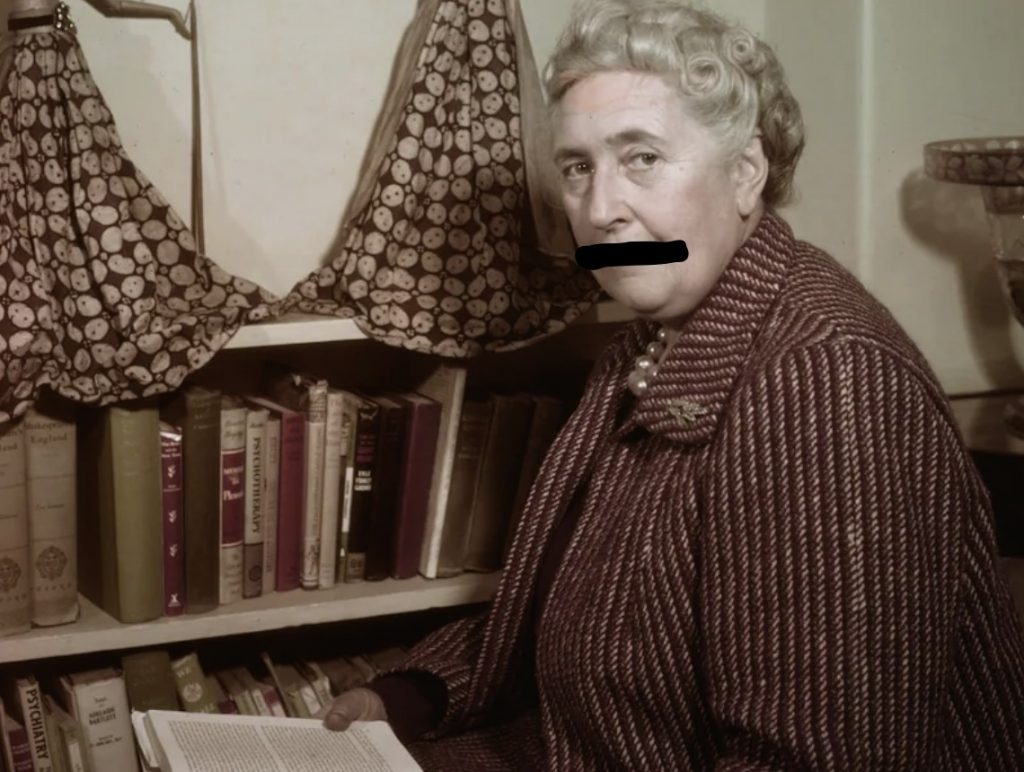
First it was Roald Dahl, now we learn the sensitivity police have been quietly roughing up Agatha Christie and Ian Fleming in the back room. How did we ever get to the point where publishers believe it’s OK to rewrite the works of dead, bestselling authors to cater for the supposed sensitivities of present-day readers? Why is this, in essence, any different from totalitarian states banning and rewriting works to suit their own ideological predilections?
Anybody who has ever enjoyed the Agatha Christie novels – and I admit to having read all 39 Hercule Poirots – knows that her greatest asset as an author is a brilliant ear for dialogue. Christie’s other great talent was as a withering satirist of all things English. An inveterate traveller, she was able to detach herself from her roots and gaze upon the foibles of her countrymen & women with a wry, critical eye. The plots, ingenious as they are, may not the most compelling element of these stories.
All this makes it even more outrageous that a group of anonymous, salaried moral guardians has been slicing and dicing Christie’s prose so imaginary readers might not be traumatised by references to teeth, noses, gypsies, black people and so on. Even the word “oriental” has been expunged, as if it were a term of offence. What makes this so infuriating is that an author’s words are carefully chosen to create a portrait of a character’s personality. Change a word and one is changing the reader’s impression of character and story.
Books written in any era necessarily reflect the historical atttudes of the time. If we have to rewrite everything in our own image the entire history of world literature will need to be done over. The sensitivity police would have to begin with Homer, eliminating most of the Iliad and the Odyssey. Once we start on this track, the whole lot must go.
While hypersensitive lefties are correcting Agatha Christie in the UK, in Tallahassee, Florida, a school principal was sacked for showing students an image of Michelangelo’s David. I’m old enough to remember when the Victorian vice squad confiscated posters of David from a shop in Melbourne in 1973. How everyone laughed and poured scorn on the ignorant coppers who thought they were protecting the public from some kind of gay porn. Now we have the same thing happening in the United States.
Add to this the growing pile of books that Florida is banning from schools, and we are back to policies and attitudes that were prominent under the Third Reich. The difference this time is that the culture warriors believe they are protecting Christian morality by blotting out anything that relates to the body, to homosexuality, to slavery, and so on. In a recent Florida textbook, the story of Rosa Parks, who refused to give up her seat on a bus to a white person in 1955, has been rewritten to omit any reference to race! Perhaps she was just an unusally grumpy passenger?
It’s an irony that these culture campaigns of the left and the right, both entail widespread censorship of art, literature and even history. Both sides would like us to believe that the world is a beautiful, anodyne place – although their versions of an ideal world are diametrically opposed. What’s more, it seems clear that these dual extremes are mutually reinforcing, with the excesses of one side encouraging the excesses of the other.
This madness is so profoundly contrary to common sense one wonders how so many people appear to have been infected with opposing strains of virulent stupidity. The origins may be traced back to a highly indadequate education system infected with political and religious prejudices, and to social media, which allows people to live within their own, alternative universes. In one of these universes, Donald Trump is nothing less than the Messiah, whose multiple persecutions are worse than the indignities inflicted on Jesus Christ. And I’m not exaggerating.
All of this makes it hard to be a person with a functioning brain, let alone a critic. When one’s job is to analyse and comment on cultural phenomena, it’s inevitable that you’ll cross a whole lot of people who operate on the basis of blind faith. Fortunately most of them don’t seem to be dedicated readers of the art or film columns, although I do get the occasional fanatical diatribe from left or right of the spectrum.
How boring the world would be if we had to conform to the views of these people. That day seems to be drawing closer all the time, but I’m optimistic that both cultural campaigns will eventually implode under the pressure of their own narrowness and fearfulness.
This week’s art column comes from Hong Kong, where the Art Basel fair was attempting a triumphant return. After more than three years of lockdowns and political unrest, Hong Kong was up and running again, with the added attractions of M+ and the Palace Museum at West Kowloon. It wasn’t quite business as usual, but there was enough to convince me that all the disruptions haven’t killed off the spirit of the place. There was far more going on during the week than I could hope to squeeze into a single article, but I’m not sure when I’ll get the time and space to comb back over some the things I saw and thought about.
At the movies, I summoned up my courage and went to see another acclaimed new Australian film. As usual, it was a depressing experience. Goran Stolevski’s Of an Age is a gay love story set in the Melbourne’s outer suburbs. It takes a long time to get started, and never quite catches fire. There’ll be no shortage of PC people willing to sing the movie’s praises, and plenty of non-PC others who simply won’t bother turning up. The night we saw the movie there was a grand total of two other viewers in the cinema, so I don’t predict a long season. Nevertheless, Stolevski is a talented director, so one hopes this rather maudlin feature is simply an itch that had to be scratched.