




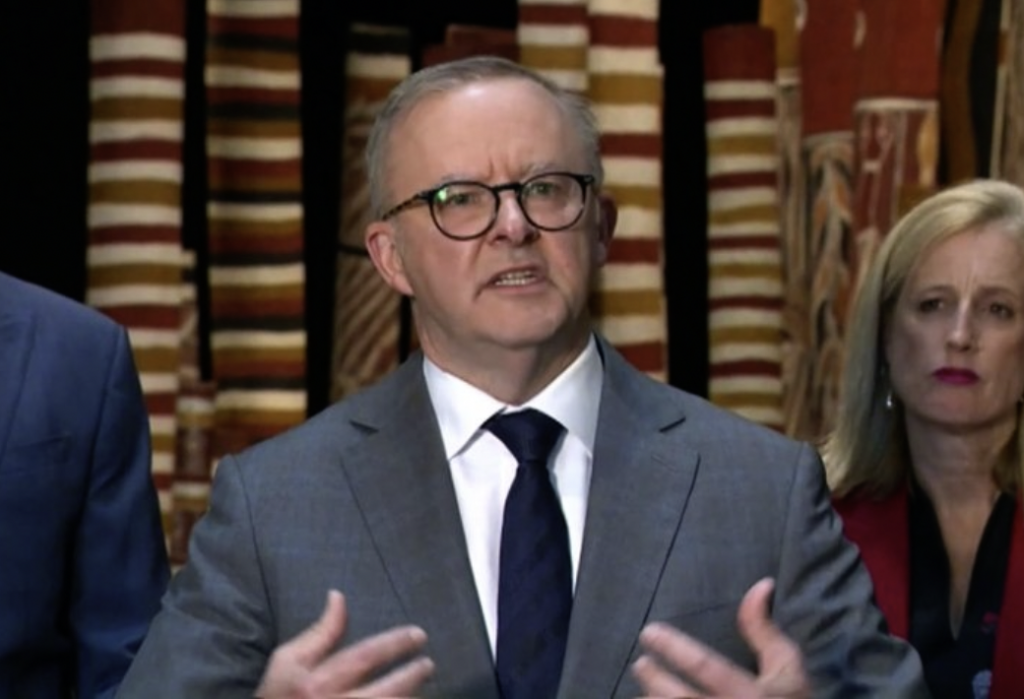
This week Albo committed $535 million over the next four years to nine national institutions. It was the most tangible gesture of support for the arts we’ve seen in decades, and a sign that the new government – as it keeps telling us – is listening.
It’s also an indictment of the Coalition’s cavalier neglect of these institutions, which have run into serious difficulties through lack of funds for general maintenance and running popular programs. Needless to say, while the slide went on inexorably, Scummo’s mob kept touting their own generosity. Spin may seem to be a cheaper alternative than capital investment, but in the long term it costs a whole lot more. Had Morrison been re-elected, the reckoning would have been postponed for another three years, while the crisis deepened.
The Sydney Morning Herald has been conducting a week-long “campaign” on the theme “Save our National Gallery”, and may now consider itself justified, but I would have been a lot happier had the paper broadened its scope to include the National Museum of Australia, the National Library of Australia, The National Archives, and so on. To focus on only one institution meant that the NGA took star billing while the others were ignored. There was never any suggestion that the NGA’s very existence was threatened – ie. it did not have to be “saved” – but there was a real possibility of further staff cuts, closure for one day a week, and so on. For the NLA, there was the looming threat that the popular Trove service would be discontinued, and for the National Film and Sound Archive, the concern that invaluable materials would be lost forever.
I’m pleased and displeased to say the government has been far more even-handed in its approach than the SMH. While the NGA naturally deserves our support, there was no acknowledgement that while crying poor in such public fashion, threatening cuts and closures, it was a very bad look to keep spending many millions on problematic works of contemporary art. Director DR. Nick Mitzevch (apparently Nick has been studying medicine in his spare time), may argue that maintenance comes from one part of the spreadsheet and acquisitions from another, but that subtle distinction will be lost on most people. The commonsense belief is that if you splurge between $20-30 million on a few works of art you have that much less in the piggy bank when a crisis arrives.
Had the money been spent on another Blue Poles, it might be viewed as a visionary investment for the future, but I doubt many pundits would view artists such as Lindy Lee, Jordan Wolfson and Tracey Emin as “iconic”. They are, one suspects, merely fashionable, and time will make these purchases look even more questionable than they do at present.
As for the NGA’s repairs bill, that’s not Dr. Nick’s fault. He inherited the problem, and has made more strenuous efforts to fix it than some of his predecessors. The real issue is that the NGA can only ever be temporarily fixed. The air conditioning alone is a never-ending headache. When I worked at the NGA about 20 years ago, I was told it would be cheaper to knock the building down and start again rather than keep patching up the air conditioning. We’re certainly not going to knock it down, so the patch-ups are facts of life that need to be budgeted-for by the NGA and the government.
The sober reality is that it costs a lot to run a set of major cultural institutions, but these are not optional extras. A nation is built on its culture, history and heritage, and museums are as necessary as schools and hospitals. They are infinitely more necessary than the mega property developments favoured by so many Coalition administrations. These national institutions are for everyone – they are public not private property, and we all need to support them.
Having said that, we don’t need to support them uncritically, as the SMH has done with the NGA. Public instititutions must be held accountable for the way they spend taxpayers’ dollars. It may be that Labor’s way of acknowledging this was to maintain the dreaded ‘efficiency dividend’, which penalises museums for failing to reach annual pre-assigned targets. This is a blunt instrument that has been shown, time and again, to be destructive and counter-productive. It doesn’t oblige museums to spend money responsibly, merely forces more draconian outcomes when things go wrong – mainly in the form of staff cut-backs.
The efficiency dividend should be consigned to history. Instead, the government might consider more rigorous and regular auditing, or a panel of review. Senate Estimates is the proper venue for asking questions, but too often these sessions are mostly political theatre.
It’s only too appropriate that this week’s art column comes from Bundanon, which has just received $33 million from the government – in the nick of time. I’m convinced that Arthur Boyd’s gift to the nation is a genuine asset, not merely a drain on the public purse. It’s important that we have a place in a rural area that can be used as a major arts hub, catering for artists, writers, composers and performers. Bundanon ticks all the boxes, and is producing exhibitions of real merit. The current show, Fantastic Forms, brings Arthur’s father, Merric Boyd, back into the spotlight and reveals an artist of great originality. By matching Merric’s drawings and ceramics with work by three contemporary artists – Nabilah Nordin, Stephen Benwell and Rubyrose Bancroft – the exhibition links past and present in a highly creative way.
The film review looks at Air, which has been receiving rave reviews everywhere, with nobody seeming to worry that it is a two-hour advertisement for Nike. As usual, I’m the mug who was perturbed by this, and have said as much in the article. It’s not that Air is a bad film – it’s fast and entertaining – it’s a matter of what it actually represents, namely a celebration of a corporate culture that has a whole closet full of skeletons, and is busy convincing us we need more and more sports shoes to achieve ultimate happiness. Apparently the average American has four pairs, with teenagers averaging 8 pairs. I wonder how many books they own?
This week I’m also including a longish piece I wrote for the Australian Financial Review on the explosion of Aboriginal Art Centres set to occur within the next 2-3 years. Having gone without a single museum of Indigenous culture for 200 years, we’re now on the verge of opening eight of them in quick succession. It’s a textbook illustration of the way the pendulum never stops in the middle, but swings from one extreme to the other, generating new problems almost instantaneously.
I’ve discussed these issues in the article, which focuses on South Australia as a test case. The question that arises from this week’s big funding announcement is: “When the government has had to find $500 million to bail out our existing institutions, how do we justify spending more than $2 billion setting up a raft of new institutions that have barely any idea about content, audiences, staffing, or all the other bread & butter issues that make a musuem tick?” What we have at present is a big bubble of good will that – sooner or later – will be pricked. The time to get the needle out is now, otherwise we’ll be seeing a future government launching a bail-out that makes last week’s efforts look like small change.