




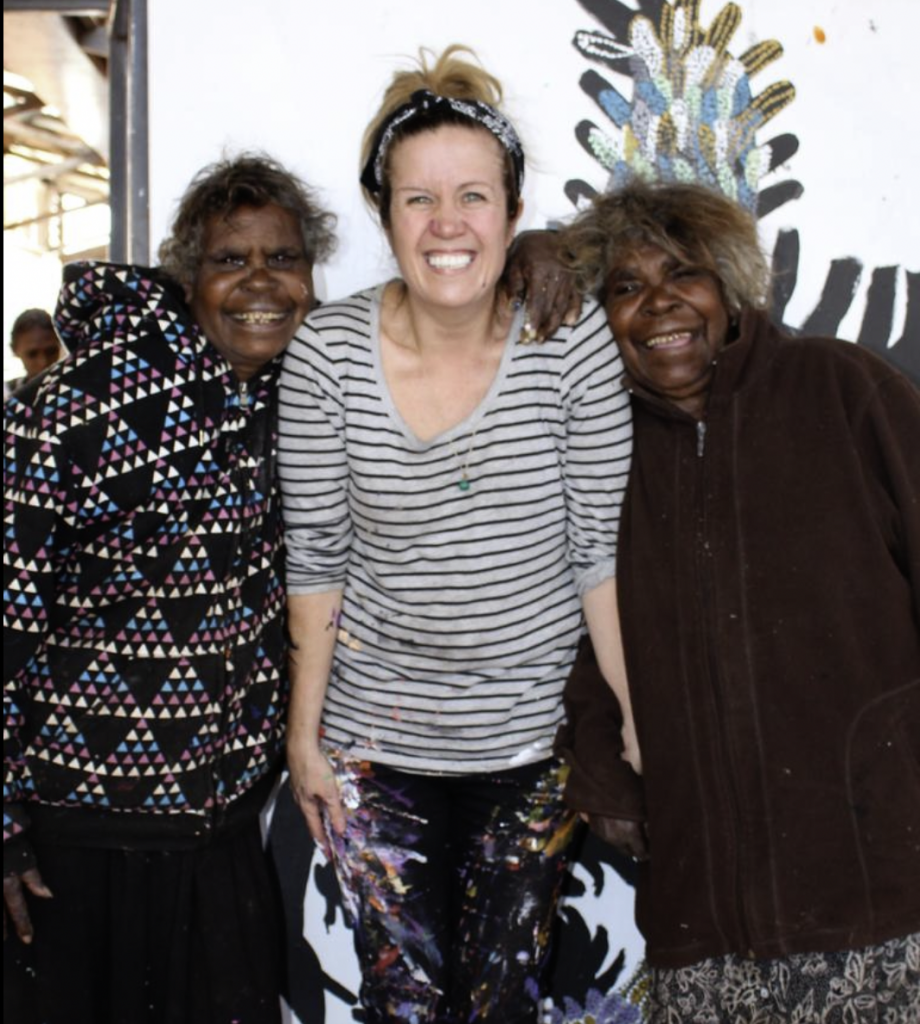
We’ve lost John Olsen, but this should not distract from the most urgent arts story of the week – a story that it has been confined almost entirely to the pages of The Australian. When the Oz finally got around to publishing Greg Bearup’s piece that effectively accuses white art assistants at the APY collective of painting works credited to wellknown Aboriginal artists, it was always going to set off a nuclear explosion in the industry. The final version of the story was so scrupulously legalled one can only guess at the threats and pressures brought to bear on the newspaper, which was up to the challenge.
Although the editorial pages of the Oz are routinely tainted by right-wing idiocies, it is one of the few places willing to do a big investigative story on an arts topic. My own paper, the Sydney Morning Herald, has fallen into the trap of feeling it has to be “supportive” of institutions such as the National Gallery of Australia, running a week-long “campaign” to argue the case for more government funding.
The need for more funding was indisputable, but this doesn’t mean that everything about the NGA is hunkdory. Policies, exhibitions and acquisitions need to be put under the spotlight, and the Oz story has created a crisis for the gallery’s winter ‘blockbuster’, Ngura Pulka – Epic Country – which was set to feature works exclusively drawn from the APY lands that are now under scrutiny.
This show – set to open on 3 June – appears an unlikely starter. The NGA initially went into denial, echoing the APY line that a video of a white art assistant painting on a canvas simply showed her applying a “background wash”. One look at the video and it’s clear this is a laughable claim. Now the gallery has announced an “independent” investigation into the level of white involvement in the works in the show. Yet there’s no detail as to who will be carrying out this investigation, nor how it can be conducted with any pretence of thoroughness only six weeks before the show is launched. Needless to say, the APY artists’ collective has strenuously denied all the charges.
From my point of view, I’ve always struggled a little with the APY work. On first impressions, the paintings are big, bold, and impressive. In last year’s Bangkok Biennale, the APY pictures were easily the stand-out paintings in the show. This has been the case on many other occasions as the sheer scale and accomplishment of the work overshadows the competition.
The problem is that after one has become familiar with the paintings and the styles involved, they begin to seem repetitive – a slick product rather than an engaging work of art denoting a deep spiritual connection with country. The word used in the Oz articles was “homogenising”, and this is spot-on. If one has looked at Aboriginal art for a long time it’s the unpredictability of the work, the meandering lines and patterns of dots, the roughness and slight awkwardness that becomes so seductive. One assumes this is, at least in part, because the artist has set out to tell a story rather than create a composition. The artists’ Tjukurrpa doesn’t play by any established western pictorial rules.
It’s the professionalism of APY painting – the very thing that has made it so popular and successful – that gives it a hollow feeling. It doesn’t surprise me to learn that white assistants may have worked on these paintings, and not only because rumours to that effect have been circulating for a long time. For me, this explains the sensation I’ve often felt in front of works that may be appreciated intellectually but have little emotional resonance. One can’t deny the skill involved, but the feeling is absent.
It’s all very well to say it’s common practice for assistants to work on a major artist’s painting. This may be OK for artists such as Ben Quilty, who has been one of the most prominent champions of the APY Collective, but there’s a world of difference between a white artist telling assistants what to do, and an Indigenous artist taking instructions from white advisers. When paintings are being marketed as authentic expressions of an artist’s Tjukurrpa, there’s no way a white assistant should be ‘juicing them up’, as we hear in the Oz video. What we are left with is a big, decorative quasi-abstract painting that may be aesthetically appealing, but can’t claim the spiritual credentials that are so prominent in the way this work is discussed and marketed.
The tragedy and danger of this scandal is that it casts a pall over the entire industry at a time when Aboriginal art is taking the world by storm. The APY collective has been at the forefront of this movement and is now rendered suspect, but other artists and communities risk becoming collateral damage. This is profoundly unfair, and will need to be worked through with maximum sensitivity if the international boom in Indigenous art is not to be derailed.
Does this make a villain of The Australian, or justify the reticence of all the other media outlets? No. It’s the task of journalism to report truthfully on such matters. If the APY collective can refute the charges, the paper will bear the opprobrium, but it’s hard to see how that’s going to happen. If there is deception involved, the media should not make a collective decision to pass over the issue because it’s important to “support” the industry, the NGA, or some other entity. Such support only ever benefits the minority at the expense of everyone else. Once a decision is made to ignore a case of wrongdoing, or even a suspicion of dubious behaviour, the problem has a habit of getting bigger. Media reluctance soon begins to resemble complicity.
Already one can see that the strategy of a blanket denial is not going to work in the face of video evidence and multiple testimonies. Instead, it seems there will be a concerted effort to direct attention away from APY towards other problems in the industry, such as the “carpetbaggers”, who operate as free agents outside of the art centre system. Alas, this is old news which won’t push the current scandal off the front page without a lot of help from media friends.
This week’s art column was supposed to present a brisk overview of The National 4, the biennal survey of contemporary Australian art that has been resurrected, over Easter, after being declared dead in 2021. I say “supposed to” because to my surprise it seems the column has been held over again, most probably to make way for more John Olsen material. Readers will know by now how I feel about these unpleasant surprises.
The movie being reviewed this week is The Innocent, a very swish, French crime comedy-drama. It’s a good example of the kind of wellmade film that can hold the broadest audience, without getting bogged down in all the ‘issues’ contemporary filmmakers feel obliged to explore. Why is it I wonder, that we take such solace in crime stories? I think I’ve read more than 60 novels by Georges Simenon.. only about 300 to go.
Finally, I’m including two John Olsen pieces: an obituary written for theAustralian Financial Review, and a kind of reminscence for the Herald. Neither piece deals adequately the life and career of this mercurial artist, but for those who are interested there’s no shortage of relevant literature. It’s ironic that the paintings of Yarritji Young, who is now at the centre of the APY scandal, are often compared to works by John Olsen. Maybe John has fans out in the desert lands.