




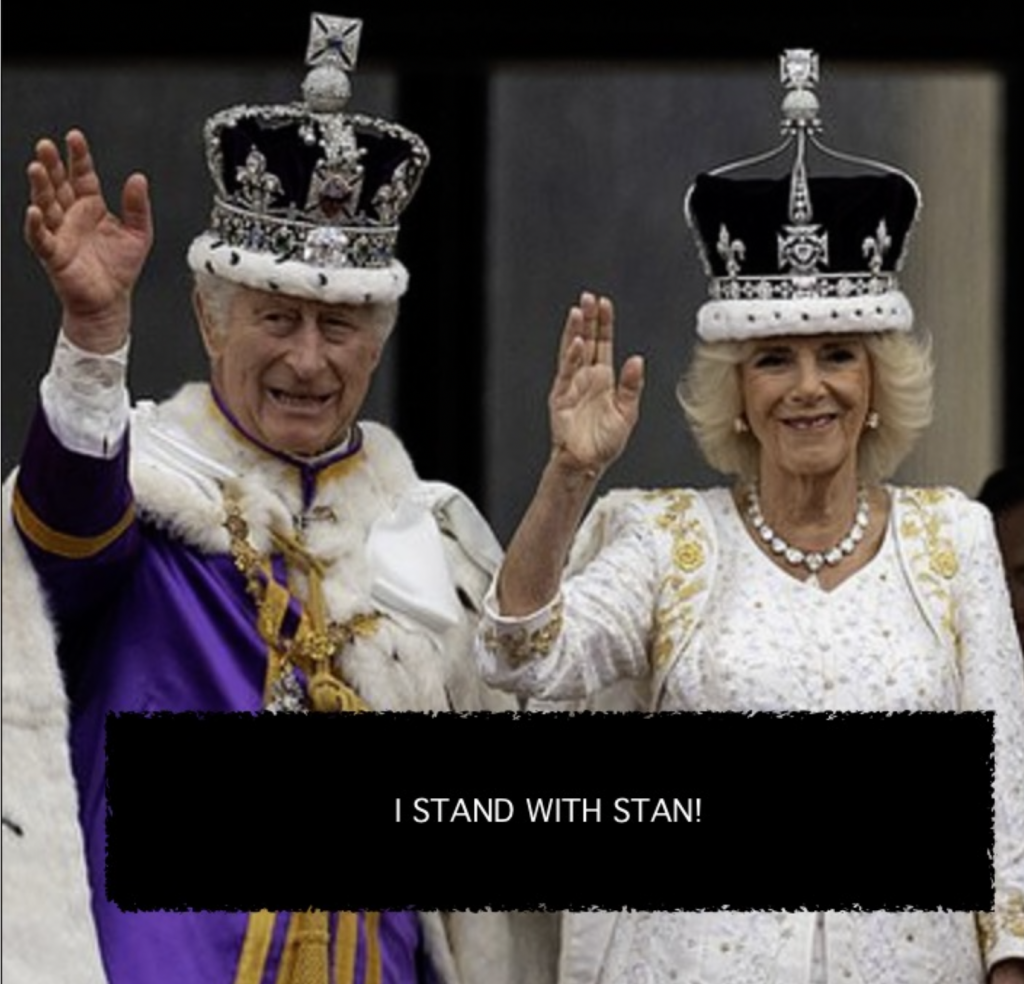
Am I the only one who doesn’t understand what’s going on with the ABC and Stan Grant? Not being enamoured of all the pomp and pageantry of the Monarchy, I didn’t tune in to the Coronation ceremonies. But after the ABC received more than a thousand complaints, I wondered whether I’d missed anything, and so watched the relevant footage on YouTube. It’s only too obvious why viewers complained.
Just to declare a position, I’m a republican who will vote ‘Yes’ for the Voice, even though I’m by no means convinced it will achieve anything of great import. Instead, I’m working on the infallible principle that anything the Boiled Egg opposes must be worth supporting.
As a student of history, I think I have an understanding of colonialism and its legacies. But when it comes to the ABC’s attempt to turn the Coronation into a one-sided history lesson, I was dumbfounded at how arrogant and short-sighted the station has become. On one side we had Aboriginal lawyer, Teela Reid; Chair of the Australian Republican Movement, Craig Foster; and journalist, Stan Grant. On the other side, representing the monarchy, Liberal MP, Julian Leeser. The presenters, Julia Baird and Jeremy Fernandez made it pretty clear whose side they were on. It was basically a pile-on, as we heard one angry denuncation of the Monarchy after another. Leeser, who has broken with his own party over his support for the Voice, has shown himself to be a principled advocate for conservative values. He did his best to sound reasonable.
Was it so hard for ABC management to remember that a large part of their audience consists of older people and country folks, who would have tuned in for the ‘pomp and ceremony’, not for a seminar on the evils of colonialism? It was a tone-deaf performance that showed to what degree the ABC is only listening to itself, not to its audience. This was clear enough when the Morrison government tried to gut the national broadcaster by cutting vital funds. In reponse, the ABC kept all the stuff the Libs found offensive and axed longstanding programs with rusted-on audiences, such as the religious program, Sunday Nights with John Cleary.
Having tuned in to a enjoy a Royal spectacle, the audience was subjected to an hour of political hectoring. If the ABC felt the need to air all these historical grievances, Coronation night was not the appropriate time.
Shortly afterwards, we find Stan Grant announcing that he’s stepping down from hosting Q + A, because he can no longer tolerate the volume of racist abuse he cops – or rather, because ABC management has not defended him adequately or voiced their support. Soon it seemed the entire staff of the ABC were speaking out on Stan’s behalf and deploring the broadcaster’s “racist” attitudes. Meanwhile, The Australian, bastion of the evil Murdoch press, which had been roundly accused of stirring up hatred for Stan and the ABC, turns around and starts writing articles deploring the broadcaster’s treatment of the journo.
It was a case of the World Turned Upside Down. Suddenly the ABC, with all its Aboriginal place names and “inclusive” policy towards presenters, was being viewed as a racist organisation, while the Oz wept tears of blood about poor, badly-treated Stan.
Although Stan Grant may be thinking: “with friends like News Corp, who needs…” I’m bemused by the way the ABC has been transformed into the major villain in this story. Stan said he was standing down for a while with “love” rather than hatred in his heart. The ABC has blamed the Murdoch media for inflaming criticism of theiir Coronation coverage, but it was as if the entire segment wore a sign saying; “Kick Me”. It was no surprise that Stan Grant should have railed against the colonial legacy – his position on such matters is well known. His problem with ABC management is that they invited him to comment, then seemed to avoid taking responsibility. It would appear the ABC is doubly to blame: first by making a very bad call over the Coronation coverage, secondly by hiding under the bed when everyone complained. Thirdly, one might add, by saying “It’s all News Corp’s doing”.
Now they are watching all their most prominent personalities denounce the “racism” in the organisation, while News Corp cheers on the denouncers. The moral of the story may be that a tax-payer funded broadcaster shouldn’t go out of its way to adopt conspicuously progressive and partisan political positions if it is not prepared to follow-through on these beliefs. It’s a textbook demonstration of the pitfalls of allowing journalism to devolve into the statement of opinions. Fox News has led the way in this regard, and the ABC should not be eager to emulate this travesty, even if it believes its opinion mongers are on the side of the angels. The ABC should take a look at Sky Channel, and shudder. Instead, they seem to want to compete on the same turf, with predictably dire results.
You may be thinking: Look who’s talking!? All he does is tell us opinions, week after week. Ah yes, but that’s the whole point of being a critic rather than a journalist, a distinction that is being lost, as professional criticism disappears from the mainstream media, and news becomes tangled up in ideology, with an unspoken list of taboos, bogeymen and sacred cows.
This week’s art column looks at the best exhibition I saw in the United States last week: Philip Guston Now, at the National Gallery of Art, Washington DC. As you’ll be able tell from the length of the column, Guston is one of those artists I can’t get enough of. His career straddles three major phases: the early left-wing activist works, produced during the Great Depression; the paintings made as a fully-fledged member of the Abstract Expressionists; and the late, cartoonish pictures that arrived like a bombshell at an exhibition in 1970.
Guston was a man of conviction in a profession that rewarded conformity (a bit like Stan Grant!). The irony of this retrospective is that it was almost derailed by concerns that the Ku Klux Klan figures in Guston’s paintings would be found offensive by hypersensitive viewers. It should have been obvious from the beginning that only Klansmen were in a position to be offended by these images. It’s Guston’s willingness to confront this evil in society and in the American psyche, that makes him more relevant than ever to a deeply divided nation.
The movie being reviewed is Limbo, the new feature from Ivan Sen, who persists in doing almost everything himself, short of frocking up and playing the heroine. The film, shot in sombre black-and-white, is worth seeing just for Simon Baker’s out-of-character performance as a depressed cop on a hopeless mission in the Outback. It’s a low-key affair, but quietly compelling – one of the best Australian films in recent years. I know that’s faint praise, but perhaps we have to get through Limbo before we begin humming Stairway to Heaven.