




In those heady days when John Wayne was dispatching hostile injuns by the dozen, no-one could have envisaged Hollywood making clean-cut white Americans into the bad guys. It would have taken a clairvoyant to predict the tide of identity politics that has swept over the United States in recent times, engendering a new generation of heroic role models that might be female or African American, Asian or Latino.
In films such as Black Panther 2: Wakanda Forever, to cite only the most glaring example, the United States is an evil empire, determined to rob the Africans of their mineral wealth by violence and treachery. It’s the tribal warriors who occupy the moral high ground.
In the Hunger Games films, we see an America of the future that has become a cruel dictatorship, an idea that seems to be gaining traction again. I could go on listing examples of Hollywood demonising a demographic it once considered its core audience, but you get the picture.
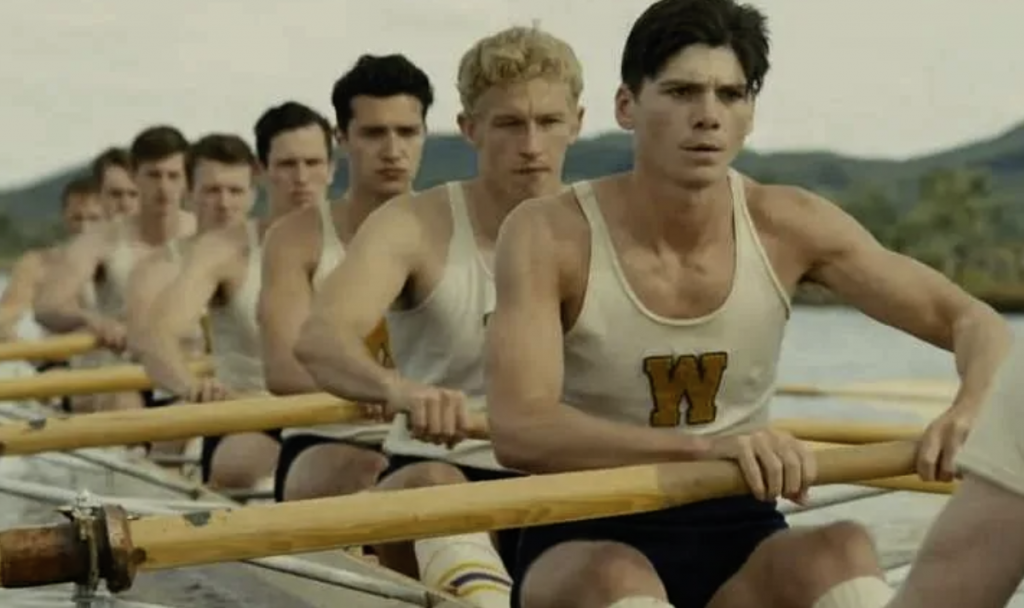
This new orthodoxy makes George’s Clooney’s The Boys in the Boat feel like a throwback to another era. It’s not just old-fashioned, it’s wilfully old-fashioned. In adapting a best-selling book by Daniel James Brown, Clooney and his scriptwriter, Mark L. Smith, have made a movie that displays all the values of another era. The story is unashamedly patriotic, a tale of working-class underdogs triumphing against impossible odds. It’s a romance that just happens to be true.
The setting is Seattle in the 1930s, when the prosperity of the tech boom was mere science fiction. In these years the effects of the Depression were still being felt, especially by a young man called Joe Rantz (Callum Turner), who had lost his mother early, and been abandoned by his father at age 14. Joe is enrolled at the University of Washington in an engineering degree but can’t afford the fees. His solution, along with his buddy, Roger (Sam Strike), is to apply to join the university’s rowing team, which comes with a promise of board and tuition.
This ambition is shared with about 400 other students, but miraculously, Joe and Roger are selected. They join the junior team for the eights, a role described by gruff coach, Al Ulbrickson (Joel Edgerton), as almost beyond human endurance. From this point it’s a predictable but engaging story of success against more fancied teams from the Ivy League universities, culminating in the ultimate challenge: representing the United States in the 1936 Berlin Olympics.
As there’s never a moment when we don’t know what’s going to happen, the interest lies in the characters themselves and the personal challenges they face. We spend a lot of time on the hardships of Joe’s life and his hesitant romance with fellow student, Joyce (Hadley Robinson). We are given a detailed account of Al’s problems, as he tries to get the team up to scratch, appease his university bosses, and negotiate one crisis after another.
Clooney’s most trenchant critics seem to be admirers of Brown’s book who are unhappy with the cuts and compressions involved in a film adaptation. For the director and scriptwriter, the first task is to decide what they want to convey to the viewer, and which scenes are most vital to that intention. Clooney and Smith apparently felt the American public, tired of wallowing in guilt and shame, was hanging out for a movie that celebrated the good ole American can-do spirit.
The only feature I’ve seen in the past few years that waved the flag so proudly was Top Gun 2 (2022). Somehow the filmmakers have resisted the temptation to make the poor white boys in the boat into a multi-racial crew. The Berlin Olympics provided an opportunity to focus on the great black athlete, Jesse Owens, but he gets no more than a cameo, telling one of the boat crew that he’s less concerned about impressing the Germans than the people back home. The political point is made with maximum economy.
One of the ironies of this patriotic production is that there are so few Americans in the cast. Callum Turner and Sam Strike are both British, as is Peter Guinness, who plays boat-builder, George Pocock. Aussie Joel Edgerton is arguably the star of the show, doing his best impersonation of the anxious, grim-faced mentor who hides his human feelings. Women, such as Hadley Robinson and Courtney Henggeler, who plays Al’s wife, Hazel, adopt supporting roles in an overwhelmingly masculine film.
This is not the first time Clooney has demonstrated his love of Golden Age Hollywood, or his willingness to indulge the most sentimental themes, but The Boys in the Boat is a huge advance on a movie such as The Monuments Men (2014), with its irritatingly jaunty approach to the Second World War. The characters are more convincing, the shots of the boat races expertly executed, and there is a clear sense of momentum in the narrative. An Alexandre Desplat score is closely fitted to task, although Chariots of Fire it ain’t.
Clooney has given us a reminder of all the reasons people once went to the cinema and suggests those preferences have been repressed but not abandoned. He’s given us a great, nostalgic wind-up toy of a film, which may not appeal to ‘sophisticated’ tastes but has already exceeded box office expectations. As movies go, I can see plenty of reasons not to like it, but I liked it anyway.

If The Boys in the Boat stirs dim echoes of Chariots of Fire (1981), Alexander Payne’s The Holdovers may conjure up memories of Peter Weir’s Dead Poet’s Society (1989). Like that earlier film, this one is set in a private boarding school for boys, but instead of Robin Williams infusing his charges with a love of poetry, we have Paul Giamatti teaching them to loathe Thucydides. Williams scored an Academy Award nomination for Best Actor, and it would be surprising if Giamatti doesn’t follow in his footsteps. The history of the cinema is staffed with inspirational teachers, from Mr. Chips to Monsieur Lazhar, but there’s something even more compelling about the misanthropic, bitter & twisted teacher everyone despises.
The year is 1970, the place is Barton Academy in up-state Massachusetts – a fictional prep school cobbled together from parts of five real schools. It’s the beginning of the Christmas holidays, and the teachers are scouting around for someone to stay at school and look after the handful of boys who, for one reason or another, are not spendng the yuletide with their families.
Inevitably the job gets foisted onto Paul Hunham (Giamatti), the Classics teacher. As Paul is a bachelor with nowhere to go, and no apparent friends, he is the logical candidate. He accepts the responsibilty with both stoicism and cynicism, having no desire to share the holiday with a group of Christmas rejects.
For the boys it’s even less fun. Paul is notorious for his acid tongue and his delight in failing the sons of tycoons and politicians. From a motley collection of five boys, most are given permission to go off on a ski trip. Now there is only one: willowy senior, Angus Tully (Dominic Sessa), whose mother has left with her new partner for a holiday in St. Kitts. At the last minute, Angus gets a phone call telling him he’s not invited because the lovebirds would like to spend some quality time together.
While the snow lies round about, the holiday becomes a battle of wills between Paul and Angus, overseen by the school cook, Mary (Da’Vine Joy Randolph), whose only son has just been killed in Vietnam. In watching the exchanges within this trio, we see a different, more sympathetic side of Paul, who drops his armour when talking with Mary. As we piece together Angus’s story, we can see his intelligence, and his deep unhappiness.
In a film that manages to be touching and consistently funny, you won’t be surpised to learn that a rapport develops between existentially miserable Paul, who seeks solace in Jim Beam and Marcus Aurelius, and prickly, troublesome Angus. It becomes a quasi father-and-son relationship, with Mary in the occasional role of mother. This conflicts with Paul’s habit of keeping everyone at a distance. A bad eye and a body odour condition he can’t control have convinced him he is nobody’s idea of an attractive companion. When the strange Miss Crane (Carrie Preston), bakes him a plate of cookies he seems alarmed.
On an excursion into Boston, Paul and Angus will learn each other’s best-kept secrets, laying bare two life stories that have been kept heretofore under wraps. If Giamatti is reliably good in the role of Paul, Dominic Sessa, on debut, is a revelation. We can expect to be hearing more about him in years to come.
The ending, both melancholy and satisfying, might even be interpreted as ‘happy’. Like so many of Payne’s protagonists, Paul is a man who has spent his life as a permanent “holdover”, going through the same rituals and routines, feeling depressed, resigned, incapable of change. The events of late 1970 force him to drop the mask of stoicism and embrace what his beloved Greeks called catharsis – a long-postponed emotional release from a stitched-up personality. It could only happen at Christmas.
The Boys in the Boat
Directed by George Clooney
Written by Mark L. Smith, after a book by Daniel James Brown
Starring: Joel Edgerton, Callum Turner, Hadley Robinson, Sam Strike, Peter Guinness, Jack Mulhern, Luke Slattery, Tom Varey, Wil Coban, Thomas Elms, Joel Phillimore, Bruce Herbelin-Earle
USA, PG, 123 mins
The Holdovers
Directed by Alexander Payne
Written by David Hemingson
Starring: Paul Giamatti, Dominic Sessa, Da’Vine Joy Randolph, Brady Hepner, Carrie Preston, Naheem Garcia, Jim Kaplan, Ian Dolley, Michael Provost, Andrew Garman
USA, M, 133 mins
Published in the Australian Financial Review, 13 January, 2024