





For the second year in a row, I’ve come away from Art Dubai with the feeling that it’s distinctly different from every other international art fair. Even as I write, one of the biggest of all fairs is getting ready to launch. Art Basel Hong Kong remains Asia’s premier commercial art event, despite challenges from Seoul and Singapore.
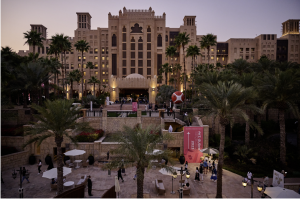
Although Dubai owes everything to trade and finance (and relatively little to the oil that underpins the wealth of its neighbour, Abu Dhabi) Art Dubai is less nakedly mercantile than any fair of comparable size. Its strengths are its strong regional base; its dedicated engagement with art history; and a special component devoted to digital art, in which one may sample all the latest cutting-edge innovations.
Now in its 17th edition, Art Dubai has reached a comfortable plateau in a country with an extraordinary degree of personal wealth. The city, which was nothing more than a sandy entrepôt for most of its history, is now home to 68,000 millionaires, attracted by a favourable tax regime, flexible business regulations, and a luxury lifestyle. In 1960 Dubai had a population of 40,000, today it houses more than 3 million people. As the city builds more office blocks and apartments for the constant influx of well-heeled migrants, the local art scene grows with it.
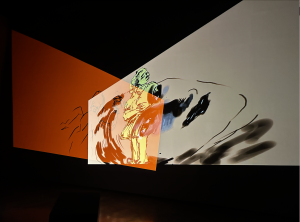
A gallery complex called Alserkal Avenue is home to a range of commercial dealerships and exhibition spaces located in a set of massive sheds. It hosts an art foundation and provides residencies for international artists, the most recent being Nalini Malani, whose expressive paintings and multi-media works have made her one of the most exportable stars of India’s booming art scene.
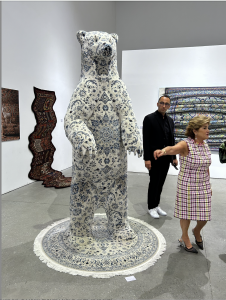
The commercial galleries at Alserkal are also willing to do museum-style shows. Leila Heller’s Carpets of Eden, Gardens of Fantasy, was an international survey of contemporary artists using carpets, with works ranging from Debbie Lawson’s life-sized bear in stylish blue-and-white, to Antonio Santin’s painstaking hyperrealist painting of a folded carpet, every thread applied by a syringe-like device.
Founded in 2007, Alserkal has always been popular among tourists but increasingly it’s Dubai residents who are buying the art. The same pattern occurred in China, 20 years ago, when Chinese galleries began to sell work to emerging local buyers. Of the 75 galleries in the Contemporary section of the art fair, 16 were based in Dubai. It’s as if there’s a moment when a reluctant local market suddenly clicks into action. Maybe it’ll happen in Australia one day!
There are some art fairs that project a palpable desperation for sales, as if the success of the event were to be measured solely in terms of turnover. The organisers of Art Dubai, while eager to see healthy sales figures, have designed the fair along lines that encourage a curatorial approach. The display was divided into four sections: Contemporary, Modern, Digital, and Bawwaba (“Gateway” in Arabic). The latter featured solo presentations on the theme of healing, selected by Guatemalan curator, Emiliano Valdés.
The digital art section may be the fair’s major claim to fame, but it’s a huge topic that deserves an article in its own right, as does the Diriyah Biennale in Riyadh which I visited following Dubai. I’m not going to try and squeeze everything into one report.
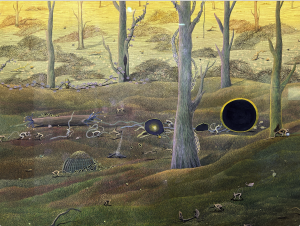
The galleries in the Bawwaba section were drawn from India, Spain, Uruguay, Portugal, Dubai and Italy, along with Galerie Extra from Valdés’s own country, Guatemala, who showed the work of Manuel Chavajay, a Mayan artist on the cusp of an international career. Another highlight was a series of detailed fantasy landscapes by Laxmipriya Panigrahi at New Dehli’s Anant Art Gallery.
The Modern section was selected by curator, Christianna Bonin, who is based in Sharjah. This time the featured artists, showing with nine galleries, hailed from Syria, Lebanon, Uganda, Sri Lanka, Egypt, Armenia, Iran, Egypt, Azerbaijan, Saudi Arabia, Yemen, Iraq and Ukraine. It’s an alternative reality to the bigger art fairs, where the international Uber galleries such as Gagosian, David Zwirner, Pace, White Cube and Hauser & Wirth, form a kind of aristocracy around which the other dealers cluster.
In Dubai this de facto class system was not to be seen. The Uber galleries were absent, and so were most of the leading aspirationals. Instead of seeing stockroom-standard pieces by big name artists, one encountered a host of unfamiliar figures represented by their best work. It may not appeal to those wealthy collectors who act like trophy hunters, valuing artworks by their price tags, but the Dubai blueprint allows for a truly global perspective, bringing together artists from regions largely ignored by the canons of western art history.
The art market may be amoral, but it is able to work on many different levels, creating opportunities for entirely new kinds of collections from areas such as the Middle East, Africa, Central Asia and the subcontinent. This is the thrill of Art Dubai: the chance to get acquainted with artists whose entire careers have been spent away from the major centres, and those who have yet to make their mark away from home.
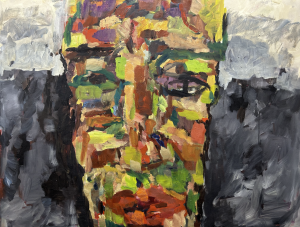
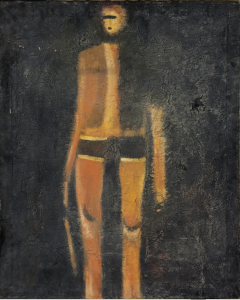
In fairs, when so many booths scream “Look-at-me!”, it can be the smaller, more modest works that stand out. In this sense, an artist such as Ashraf Murad (1925-79) at Gazelli Art House (Baku/London) was a real discovery. An Azerbaijani modernist whose first exhibition was held five years after his death, Murad was one of many artists who suffered under the former Soviet Union. A selection of small, dark, crudely painted figures and still lifes, captures the atmosphere of that period, while also marking the artist’s secret rebellion. This section also included Marwan (1934-2016), showing at Dubai’s Meem Gallery. Born in Syria, the artist spent most of his life in Berlin, painting in a powerful, expressionist manner. He has now been reclaimed as a Middle Eastern modernist, with soaring auction prices.
The Contemporary section was by far the largest component of the fair, featuring galleries from Europe, the USA, South America, India, Iran, and South-East Asia, although Australia was missing in action. Given the state of the world today, two of the most significant inclusions were from the Palestinian city of Ramallah. Last year there was a gallery from Gaza, although it’s unlikely it still exists.
Everything at Zawyeh Gallery related to the politics of occupation, featuring a group of artists who came up with ingenious, oblique ways of expressing themelves. Khaled Hourani’s bright, innocuous-looking prints of watermelons are widely recognised symbols of resistance, their colours encoding those of the Palestinian flag.
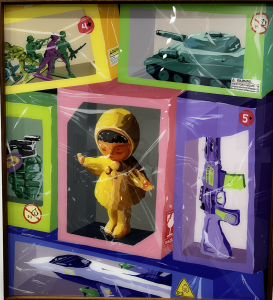
Saher Nasser found another way to address the war in a painting of a doll in a shop window, surrounded by toy planes, guns, tanks and soldiers. It’s an image of brooding violence wrapped in cellophane and pop art colours. For Zawyeh and the other Ramallah exhibitor, Gallery One, the art fairs are a lifeline at a time when normal business has been closed down by the war.
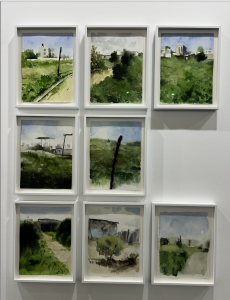
Another Palestinian artist, Taysir Batniji, showing with German gallery, Sfeir-Semler, contributed a deadpan series of watercolours called Jour tranquilles à Shujaiya (2023), showing desolate images of one of Gaza’s largest neighbourhoods.
Spare a thought as well for those Israeli artists, who find themselves in a similar position to the Russian tennis players suffered the fallout from Putin’s war in the Ukraine. Mr. Netanyahu’s aggression has done no favours to artists from Israel who are enduring boycotts and protests, regardless of their political beliefs. A campaign to exclude them from the Venice Biennale is fast gathering momentum.
There’s a book waiting to be written on the art emerging from the war in Palestine, as artists struggle to find ways of dealing with unthinkable realities. It may seem ironic that a commercial art fair in one of world’s enclaves of high finance, should be so affected by the devastation in Gaza, but when an event sets out to engage intensively with the art and history of the region, there’s no way to avoid such conflicts. The turbulent nature of the Middle East may have hindered the Arab world’s cultural engagements, but it has also produced artists who grapple with fear, anger and frustration in their daily lives, occasionally finding traces of beauty amid the ruins.
17th Art Dubai, 28 February – 3 March 2024
Published in the Sydney Morning Herald, 30 March, 2024
John McDonald was a guest of Art Dubai