




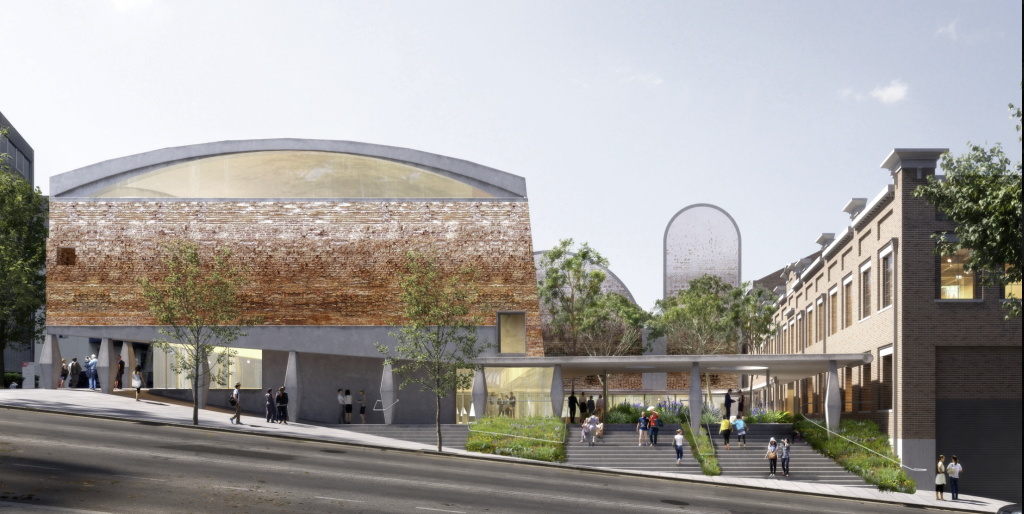
There’s such a flood of propaganda coming from the Powerhouse Museum, I can barely bring myself to look at it. That, I presume, would be a highly desirable outcome for PHM director, Lisa Havilah; NSW Arts Minister, John Graham, and everyone else who’s involved in the business of full-scale cultural vandalism.
We know from the director’s own boast in a public address that her preferred strategy is never to respond to criticism, merely wait until the dust settles and carry on doing whatever she wants. To this tried & true formula, one might add: “And then send out a stack of upbeat press releases, pretending that black is white and white is black.”
As anyone knows who has sampled the precise, comprehensive analyses of the PHM saga written by Kylie Winkworth, Lindsay Sharp, and other alumni of the museum, almost everything we read in the official press releases is a lie. The much-vaunted “Community consulations” have been a farce and a smokescreen, intended only to tick a box, allowing the government to pretend they have listened to their critics. This is a familiar pattern for everyone who has made a submission to one of these events.
The point of this bogus “consultation” is simply to rubber stamp the destructive, wasteful, completely unnecessary scheme that is being pushed through in defiance of public wishes and expert opinion. To discuss the actual detail of the government’s Orwellian “revitalisation” plan would require many thousands of words. By way of a summary, I’ll refer to Linda Morris’s article in the Sydney Morning Herald on 3 May, in which “Infrastructure NSW chief executive Tom Gellibrand said the revitalised Powerhouse Ultimo would result in more exhibition space overall, not less, and ‘vastly improved’ spaces.”
Mr. Gellibrand’s idea of a “vastly improved space” seems to mean a bigger space, in which those pesky mezzanines that currently house galleries, will have been removed. This will result in large, cavernous spaces suitable for rave parties, but not for exhibitions. The actual amount of exhibition space will be severely curtailed. Kylie Winkworth notes that when the PHM opened in 1988 it had 25 exhibition spaces. The proposed “revitalisation” would turn this into three large party venues. The thinking seems to be that exhibitions cost time and money, while venue hire is instant and brings in revenue. Is this the new model for museums in NSW?
By now we should be deeply suspicious of the idea that a large, cavernous space provides a great design for a museum. Col Madigan tried that, with the best of intentions, in his design for the National Gallery of Australia, and there has never been a moment when the entry-level galleries have actually worked. Put paintings in a giant-sized space and they become postage stamps. Lighting becomes difficult and expensive, while all sense of intimate engagement with an object is lost.
Sydney Modern – or Naala Badu (!) – provides another case in point: huge, empty spaces completely unsuitable for exhibitions but great for parties, unless you’re standing outside in the sun or the rain.
Now the PHM is to be remade in similar style: large spaces as function venues, less space for shows, with a few big objects from the existing display being kept as decorations, devoid of context.
The plan promises: “Three exhibition spaces [that] will be capable of hosting touring international shows of importance such as Ramses: Gold of the Pharaohs, currently drawing hundreds of thousands of visitors to the Australian Museum.”
We’re back at the apogee of dishonesty. There is absolutely no reason why a show such as Ramses could not fit into the existing PHM. There is more than adequate space if Havilah and her croneys had the wherewithall to obtain such a show. This is reminiscent of the AGNSW’s duplicitous argument that Sydney Modern was a necessity because there was inadequate space for temporary exhibitions in the existing building – even when 2-3 galleries were vacant or filled with any old thing. The joke, of course, is that Sydney Modern went an entire year without a single exhibition.
For the Australian Museum to be invoked in the same breath as the PHM is an insult to the former. The suggestion is that a ‘revitalised’ PHM would be able to hold a show like Ramses, and draw “hundreds of thousands of visitors”. This is simply ridiculous. The AM is the best run, and lately, best attended museum in Sydney. It is a far more complex proposition than most museums, as it also has a scientific research component. The PHM, which has absorbed well over a billion dollars in taxpayers’ funds over the past decade, has lost money at an astonishing rate. But “lost” is perhaps the wrong word. While attendances returned to the level of the early 1960s, hundreds of thousands – millions – of dollars have been squandered on artist’s commisions, payments to “associate artists”, and purchases of dubious relevance. How are these privileged artists chosen? You’ll have to ask Lisa Havilah. It’s not space that prevents the PHM holding a show like Ramses, it’s a lack of competence, and – by the director’s own admission – a distaste for “blockbusters”.
Has the NSW government ever discussed this preference with their annointed PHM boss? Her idea of a blockbuster was Gucci Garden.
Among the innovations in the new plan are: “a new entrance reoriented to the Goods Line and Chinatown, an internal courtyard protected from the elements, overnight dormitories for visiting country school children, a new loading dock, library and eight workshops for creative workers that will open to Harris Street.
The new entrance, courtyard and loading dock are expensive and unnecessary. The library is fine where it is. And why, oh why is the PHM turning itself into a youth hostel, and a hang-out for “creative workers”? This is so far from anything that a museum should be doing, it’s hard to see what the new Powerhouse Ultimo will actually be – which may be why Lisa Havilah was so keen to “rebrand” the institution minus the word “museum”.
Under the “revitalisation” plan, everything that John Graham promised to preserve, is in fact being destroyed. The old chestnut about “creating jobs” and adding an abstract figure of $34 million (why not $340 million?) to the economy is being dragged out in the most cynical fashion. How many times have we listened to this kind of stuff? How many times does the public need to have its intelligence insulted?
And don’t forget, this all began with the former Coalition government. Labor, which came to power with a promise to preserve the PHM, has broken its word on every point, and is now trying to spin its way out of this quagmire of betrayal, dishonesty and bad faith.
At this stage, the only hope for the PHM lies with the Heritage Council, which is considering expanding heritage protections at Ultimo. Will this be powerful enough to preserve the building? A heritage listing didn’t prevent the demolition of the Victorian house, Willow Grove, to make way for the $1.2 billion milkcrate in Parramatta. Apologies for my apparent monomania on this issue, but the sheer scale of the disaster, the huge amounts of money being wasted, and the stupendous dishonesty involved – all to achieve a negative result that will continue to cost millions – is enough to strain anyone’s sanity.
To end with a small epiphany that helps prove a point, an anonymous reader recently sent me photos of the restrooms in the PHM’s new Castle Hill depot. Each photo featured a bottle of Aesop hand wash, priced on-line at $53 a pop. An equivalent product may be purchased at Chemist Warehouse for about $3. I haven’t been out to cconfirm this first-hand, but if PHM management is really spending $50 a bottle on handwash, it says a lot about their attitude towards money. I hope the Treasurer, Daniel Mookhey, has been sent the same letter.
This week’s art column looks at William Kentridge’s show at Annandale Galleries, but more particularly at the way the artist engages creatively with history. The intelligence and imagination in Kentridge’s work led me back to the Sydney Biennale, in which history is treated in more cavalier fashion. The idea was to write a kind of mini-essay about the use of history in art. When, I made the fatal mistake of looking at the printed version in the weekend paper, I found the Herald had completely mangled the piece in a way that shouldn’t surprise me by now. All I can do, as ever, is suggest that one reads the versions on the website, which remain as they were originally written.
The film being reviewed is Golda, the bio-pic of former Israeli Prime Minister, Golda Meir, with Helen Mirren in the lead role. Has ever a film arrived at a more inopportune time? It would be unfair on the movie to see it as an endorsement of Benjamin Netanyahu’s government, although there are certain echoes. I’m also looking at Fremont, about an Afghan refugee in the United States, suffering from those bleak, disjointed feelings that afflict people forcefully parted fom their homelands. There’ll be a lot more in that category when the conflict in Gaza is over.
Finally, I’m adding a piece on I Know Where I’m Going (1945), a film by Michael Powell and Emeric Pressburger that I introduced last weekend at the Cinema Reborn Festival, at the Randwick Ritz. I’m told that this year the festival got record attendances, which suggests there is still a hard core of people out there who want to watch classic films on the big screen. One imagines here’s also a small subculture who would like to go to museums and galleries to see exhibitions rather than attend cocktail parties or raves. With every passing week in NSW, it seems these modest expectations are becoming hader to satisfy.